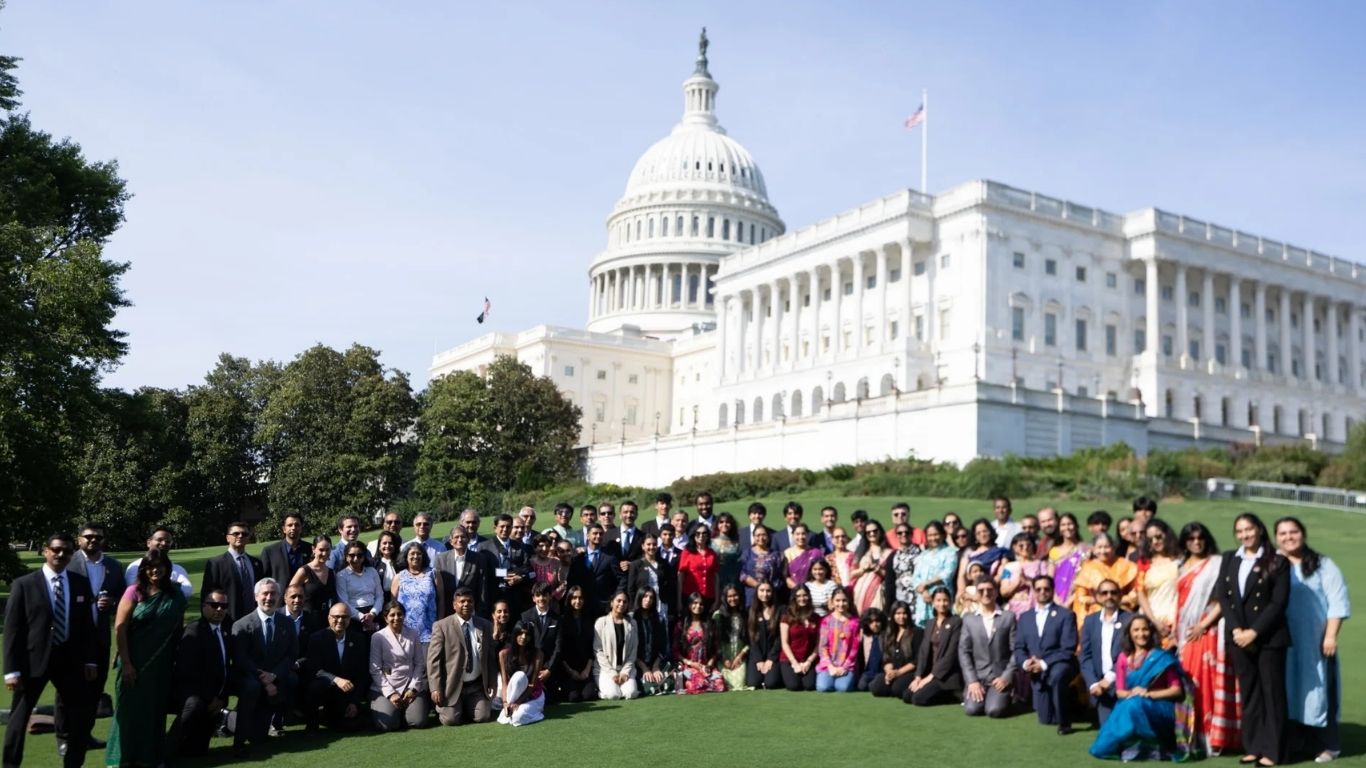
WASHINGTON (Diya TV) — Bipartisan lawmakers voiced support for Hindu Americans during the fifth annual Advocacy Day hosted by the Coalition of Hindus of North America (CoHNA) on Capitol Hill. The event brought together more than 130 Hindu Americans from 15 states to discuss religious freedom, rising anti-Hindu hate, civic engagement, and the nation’s upcoming 250th anniversary.
The gathering highlighted the growing political participation of Hindu Americans. Participants included students, veterans, business owners, researchers,s and community leaders. Before the event, delegates met with staff members from Senate and House offices. They held more than 50 meetings and visited over 120 congressional offices. As a result, they shared community concerns and strengthened ties with lawmakers.
CoHNA President Nikunj Trivedi said the event celebrated both American values and the contributions of Hindu Americans. He said the community represents people from many professions, including teachers, engineers, scientists, entrepreneurs, retail workers, and veterans. He also said the event helped educate lawmakers while building stronger relationships across faiths and political parties.
The program featured speakers from the Armenian and Jewish communities. A city council member from Maple Grove, Minnesota, also attended. In addition, members of CoHNA’s Youth Action Network shared their experiences with campus advocacy.
Students from Rutgers University described their efforts to improve Hindu representation on campus. They spoke about challenging what they described as Hinduphobic events, working with university leaders,s and later organizing an academic conference on Hinduism. Meanwhile, another youth leader discussed the influence of Hindu ideas during America’s founding period and encouraged greater civic participation among young Hindu Americans.
Army veteran Ruchir Bakshi also addressed the audience. He reflected on his military service in Afghanistan and Iraq. He said the Bhagavad Gita taught him to serve with discipline, integrity, and self-control. He added that Hindu values can strengthen civic engagement without weakening religious identity.
Lawmakers from both major political parties focused on concerns about anti-Hindu hate, temple vandalism and religious freedom. At the same time, they praised the growing role of Hindu Americans in public life.
Rep. Buddy Carter, a Republican from Georgia, called religious freedom one of America’s greatest rights. He condemned attacks on Hindu temples and thanked Hindu Americans for contributing to what he described as America’s democratic experiment.
Rep. Shri Thanedar, a Democrat from Michigan, praised immigrant communities for helping build the country’s success. He encouraged Hindu Americans to seek greater recognition for their achievements in science, medicine, education, and public service.
Rep. Suhas Subramanyam, a Democrat from Virginia, urged young Hindus to reject hate and speak with confidence. He encouraged them to embrace their identity and remain proud of their heritage.
Several lawmakers also discussed policy issues affecting Hindu Americans. Rep. Zoe Lofgren, a Democrat from California, warned that caste-based legislation could increase discrimination instead of solving existing concerns. Rep. Sanford Bishop, a Democrat from Georgia, called Hinduphobia “un-American.” He also pointed to Georgia as the first state to formally condemn anti-Hindu hate.
Rep. Brian Jack, a Republican from Georgia, highlighted Georgia’s efforts to address Hinduphobia. He also praised CoHNA’s annual advocacy program and encouraged continued civic engagement. Rep. Rich McCormick, another Georgia Republican, closed the event by praising Hindu Americans for their work ethic, family values, and contributions to American society.
The conference also included research presentations on public policy and online hate. Dr. Joel Finkelstein, co-director of the Network Contagion Research Institute, discussed debates over adding caste to U.S. laws and educational policies. He said his research found little evidence of a widespread caste hierarchy among Hindu Americans. Therefore, he urged policymakers to rely on stronger evidence before adopting new legal measures.
Researcher Prasiddha Sudhakar presented findings on online hostility targeting Hindu Americans. She said public debates over immigration evolved into broader attacks against Hindus, their religious traditions, and temples. According to her research, viral social media posts, coordinated online campaigns,s and foreign influence helped spread anti-Hindu narratives.
Political strategist Anang Mittal introduced the Citation Integrity Dashboard, a nonpartisan tool that reviews the quality and transparency of research used in public policy debates. He said the platform encourages readers to examine evidence carefully instead of accepting claims without verification.
Sudha Jagannathan, CoHNA’s director of government relations, said the event showed growing bipartisan support for religious freedom and opposition to anti-Hindu hate. She added that consistent civic engagement remains essential because lasting change depends on active participation.