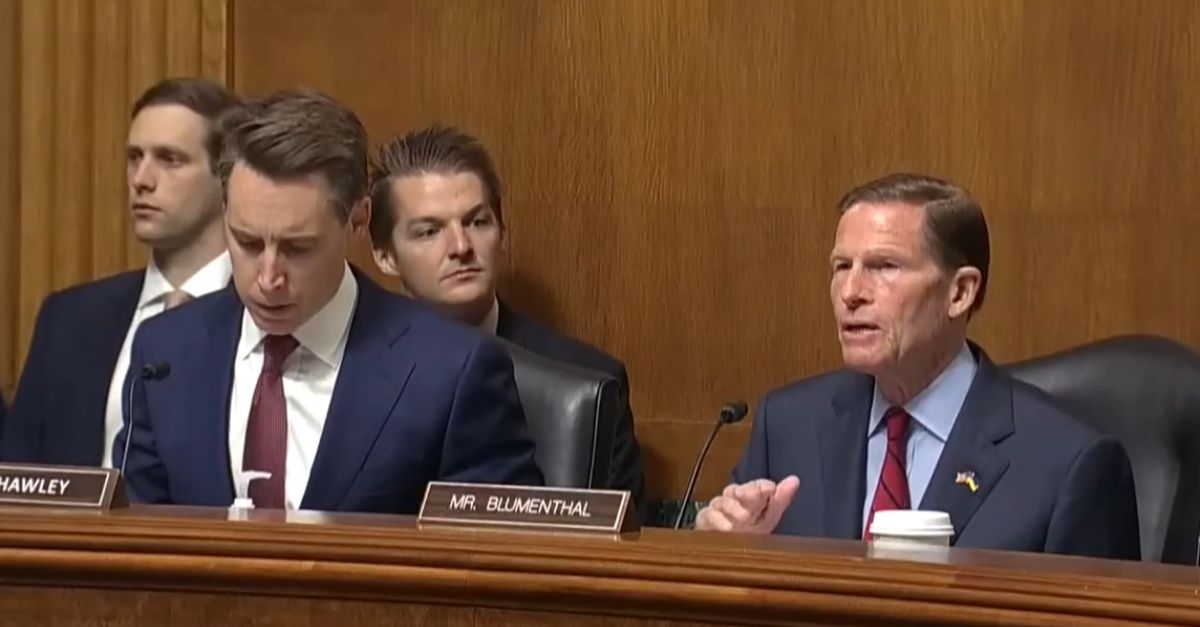
WASHINGTON (Diya TV) — Two U.S. senators from opposite parties have introduced the first bipartisan bill in Congress aimed at stopping data centers from driving up Americans’ electric bills. Sens. Josh Hawley, R-Mo., and Richard Blumenthal, D-Conn., unveiled the proposal Wednesday as concerns grow over the rising energy demands of artificial intelligence and large-scale data centers. Lawmakers at both the federal and state levels have begun pushing for action as utility costs climb in some regions.
The legislation, called the “Guaranteeing Rate Insulation” or “GRID” Act, seeks to shield consumers from data center-related electricity rate increases. It also aims to give households and small businesses priority access to the power grid. Hawley said families should not bear the cost of the rapid expansion of AI infrastructure.
“American families should not have to shoulder the burden of the rising electricity costs produced by data centers in Missouri and across the country,” Hawley said in a statement. “This is unacceptable.”
Blumenthal echoed that concern. He said major technology companies must not shift the cost of their energy use onto everyday Americans.
“Families should not be forced to bankroll Big Tech’s electricity and infrastructure costs,” Blumenthal said. He described the rapid growth of AI as an “AI-driven drain on families’ pocketbooks.”
The GRID Act would require new data centers to rely on off-grid power sources. Companies could build their own power generation systems or use independent energy supplies. Existing data centers would receive a 10-year transition period to comply. The bill would also require data center operators to publicly disclose their current and projected electricity use. Lawmakers say that transparency would help regulators and consumers better understand the impact of AI data centers on local power grids.
Data centers form the backbone of artificial intelligence, cloud computing, and digital services. They run on vast amounts of electricity to power servers and cooling systems. As AI tools expand, energy demand has surged. Utility regulators in several states have warned that new data centers could strain local power grids. Some residents have reported higher electric bills as utilities invest in grid upgrades and new generation capacity.
The bipartisan proposal follows several Democratic-led efforts in Congress. Last month, Sen. Chris Van Hollen, D-Md., introduced the “Power for the People” Act. Reps. Mike Levin, D-Calif., and Kathy Castor, D-Fla., introduced the “SHIELD Act.” Rep. Rob Menendez, D-N.J., proposed the “PRICE Act.” In December, Rep. Greg Landsman, D-Ohio, introduced the “Protecting Families from AI Data Center Energy Costs Act.”
The Hawley-Blumenthal bill marks the first bipartisan attempt in Congress focused specifically on preventing data center power usage from increasing consumer electricity bills.
The issue has also drawn attention from President Donald Trump, who has made AI development and data center expansion central to his economic agenda. Last month, Trump said his administration was working to prevent electricity rate hikes tied to data centers.
“I never want Americans to pay higher Electricity bills because of Data Centers,” Trump posted on Truth Social. He added that while data centers support economic growth and national security, “the big Technology Companies who build them must ‘pay their own way.’”
Trump has promoted the United States as a global leader in artificial intelligence. At the same time, he has signaled support for policies that protect consumers from higher energy costs.
State leaders have also taken steps to address the impact of data center energy consumption. Pennsylvania Gov. Josh Shapiro recently announced new state guidelines for data centers and urged lawmakers to pass them into law. He said the rules would help balance economic development with consumer protection.
The technology industry remains divided over these proposals. Some companies, including Microsoft, have shown a willingness to invest in independent energy sources. They have explored nuclear, solar, and other power options to support their data centers. Other companies argue they already pay market rates for electricity. They warn that new regulations could slow innovation and raise costs for businesses and consumers.