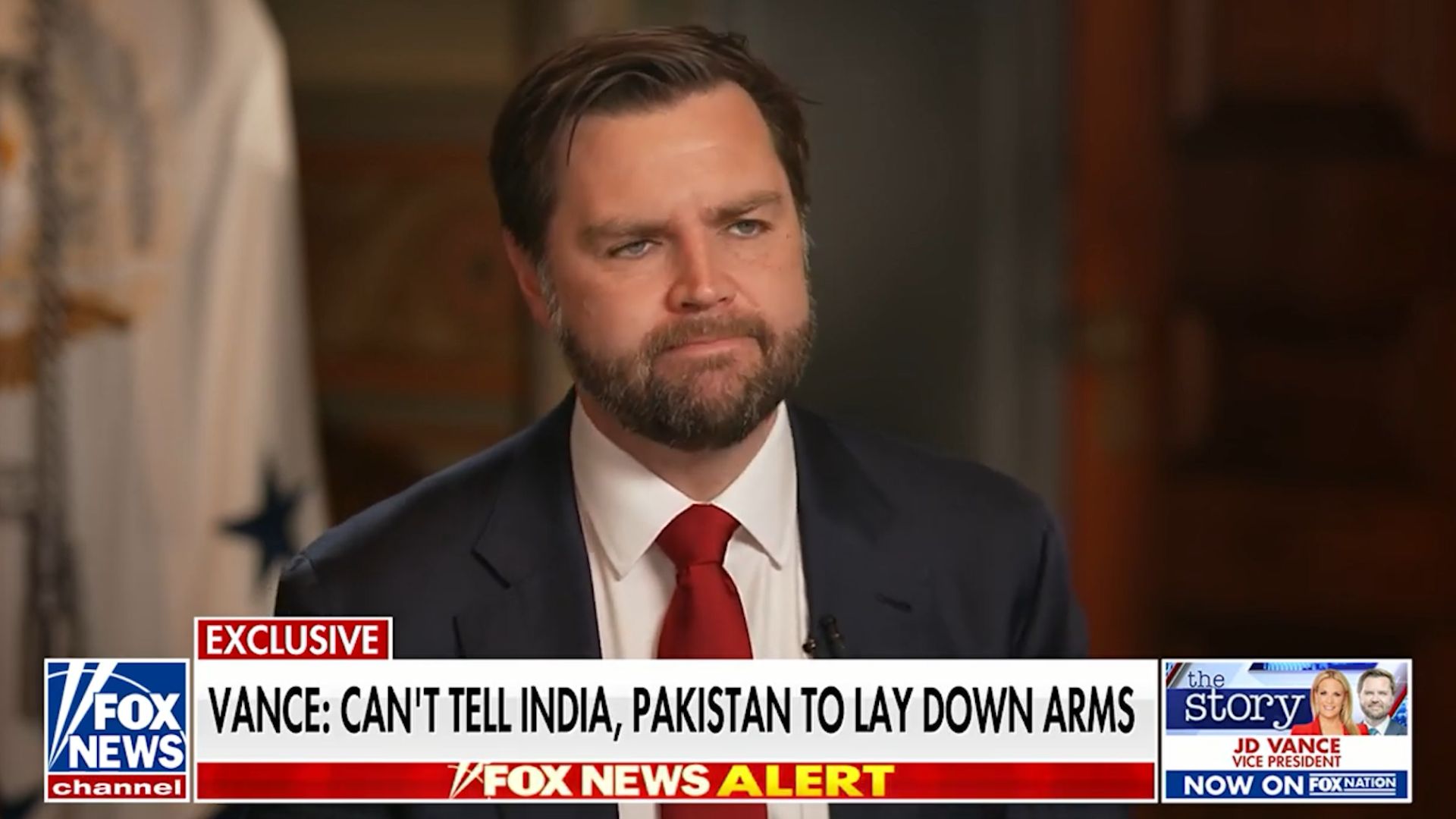
WASHINGTON (Diya TV) — Vice President JD Vance weighed in on the ongoing conflict between India and Pakistan, saying the situation is “fundamentally none of our business” and emphasized that the United States will not insert itself into a dispute where it holds limited influence.
Speaking to Fox News Thursday, Vance made clear that while Washington hopes to see tensions ease between the two nuclear-armed neighbors, direct American intervention is off the table.
“What we can do is try to encourage these folks to deescalate a little bit,” Vance said. “But we’re not going to get involved in the middle of a war that’s fundamentally none of our business and has nothing to do with America’s ability to control it.”
The vice president’s comments come amid heightened tensions along the India-Pakistan border, following a series of military engagements and rising rhetoric on both sides. Regional experts have warned that continued hostilities could risk broader destabilization in South Asia, a region home to a quarter of the world’s population and two of its largest militaries.
Despite growing concern internationally, Vance signaled that the White House sees no immediate threat of the situation spiraling into a larger crisis. “Our hope and our expectation is that this is not going to spiral into a broader regional war or, God forbid, a nuclear conflict,” he said. “Right now, we don’t think that’s going to happen.”
Vance’s remarks reflect a clear shift in tone from previous administrations that have traditionally played more hands-on roles in mediating India-Pakistan tensions. Past U.S. presidents and secretaries of state often acted as behind-the-scenes brokers or offered public support for de-escalation strategies, especially during flashpoints such as the 2019 Balakot airstrikes or the 2001–02 military standoff.
However, Vance emphasized the limits of U.S. influence in this latest crisis, pointing to the deeply entrenched national interests and long-standing grievances between New Delhi and Islamabad.
“America can’t tell the Indians to lay down their arms. We can’t tell the Pakistanis to lay down their arms,” he said. “We’re going to continue to pursue this thing through diplomatic channels.”
As part of that diplomatic approach, State Department officials have reportedly been in contact with counterparts in both countries, encouraging backchannel dialogue and confidence-building measures, according to a senior administration source who requested anonymity due to the sensitive nature of the talks.
Meanwhile, international observers, including the United Nations and several European governments, have called for restraint and a renewed commitment to peace talks. Both India and Pakistan possess nuclear arsenals, and any escalation raises concerns about a possible catastrophic miscalculation.
In New Delhi and Islamabad, the response to U.S. comments has been mixed. Indian media largely focused on America’s reluctance to intervene, with some analysts interpreting Vance’s position as a green light for India to manage its national security interests independently. In Pakistan, editorial reactions have been more critical, with several outlets expressing disappointment over what they see as a lack of U.S. engagement in regional stability.
Despite his blunt language, Vance did not completely rule out American involvement, instead framing Washington’s role as a facilitator for peace rather than an enforcer of outcomes.
“We’re watching this very closely,” he said. “We understand the stakes. But at the end of the day, this is something these countries have to resolve themselves.”
The India-Pakistan conflict remains one of the world’s most intractable geopolitical challenges, rooted in decades of hostility over the disputed region of Kashmir.