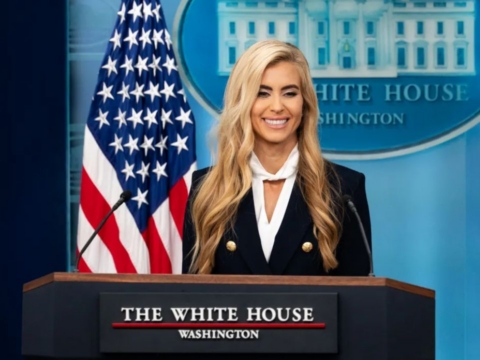

COLUMBUS, Ohio (Diya TV) — Indian American lawyer Mehek Cooke has entered a growing debate inside the U.S. conservative movement, arguing that being American has nothing to do with ancestry and everything to do with legality and assimilation. Her remarks come amid renewed arguments over immigration, identity, and the controversial term “anchor baby,” now frequently aimed at GOP leader Vivek Ramaswamy.
Cooke shared her views in a post on X after attending Turning Point USA’s AmericaFest, where Ramaswamy addressed racism and antisemitism within parts of the right wing.
“I am American. I came here legally and assimilated,” Cooke wrote. “No one gets to rank my Americanness. The real divide is not heritage. It is legality and assimilation.”
Cooke later said she spoke with Ramaswamy backstage and praised his clarity on the issue.
Born in India, Cooke moved to the United States as a child and grew up in Ohio. She now serves as president of American Frontier Strategies. Her past roles include work in the Ohio Governor’s Office and the U.S. Attorney’s Office for the Southern District of Ohio. She is also a frequent media commentator and a former surrogate for the Republican National Committee, advising on immigration, elections, and national security.
Cooke’s comments followed Ramaswamy’s high-profile speech at AmericaFest. There, he criticized racist and antisemitic rhetoric within conservative circles. His remarks came after far-right activist Nick Fuentes used a slur to describe Vice President JD Vance’s wife, Usha Vance, who is of Indian origin.
Ramaswamy has also pushed back against what he calls “heritage Americanism,” the idea that people with colonial-era roots are more American than others. In a recent New York Times op-ed, Ramaswamy wrote that Americanness is not based on ancestry. He described it as binary, not a scale.
“You are an American if you believe in the Constitution and the rule of law,” he wrote, adding that citizenship and allegiance to the United States define national identity.
Fuentes responded to Ramaswamy’s op-ed by calling him an “anchor baby,” a term widely viewed as offensive and derogatory. Fuentes argued that people he views as foreigners should not define what it means to be American.
According to Dictionary.com, “anchor baby” refers to a child born in a country with birthright citizenship to undocumented parents, often implying the birth was planned to secure legal status for the family. The term entered mainstream political debate in the mid-2000s during heated arguments over border security and immigration reform.
Scholars trace earlier versions of the phrase to the 1980s. Its modern usage grew during protests and debates following failed immigration bills in Congress in 2005 and 2006. Over time, the term became a staple of hard-line immigration rhetoric.
The facts do not support that claim.
Ramaswamy was born and raised in Cincinnati, Ohio. His parents immigrated to the United States from Kerala, India, through legal channels. His father built a career as an engineer and patent attorney at General Electric. His mother worked as a geriatric psychiatrist.
Under the 14th Amendment, anyone born on U.S. soil is a U.S. citizen. In a 2024 conversation with Iowa Gov. Kim Reynolds, Ramaswamy said his mother became a naturalized citizen. His father chose not to, for personal reasons. Because his parents immigrated legally, and because birthright citizenship applies, Ramaswamy does not fit the definition of an “anchor baby.”
Immigration remains one of the most divisive issues in American politics. During President Donald Trump’s second term, enforcement actions, ICE raids, and debates over work visas kept the topic in headlines. The renewed use of “anchor baby” reflects a deeper question that continues to divide voters: Who gets to be called an American?
For critics like Cooke and Ramaswamy, the answer centers on citizenship, law, and shared civic values. For others, identity politics and exclusion still play a role. As the debate intensifies, the language used reveals as much about political ideology as it does about immigration policy in a nation built by immigrants.