
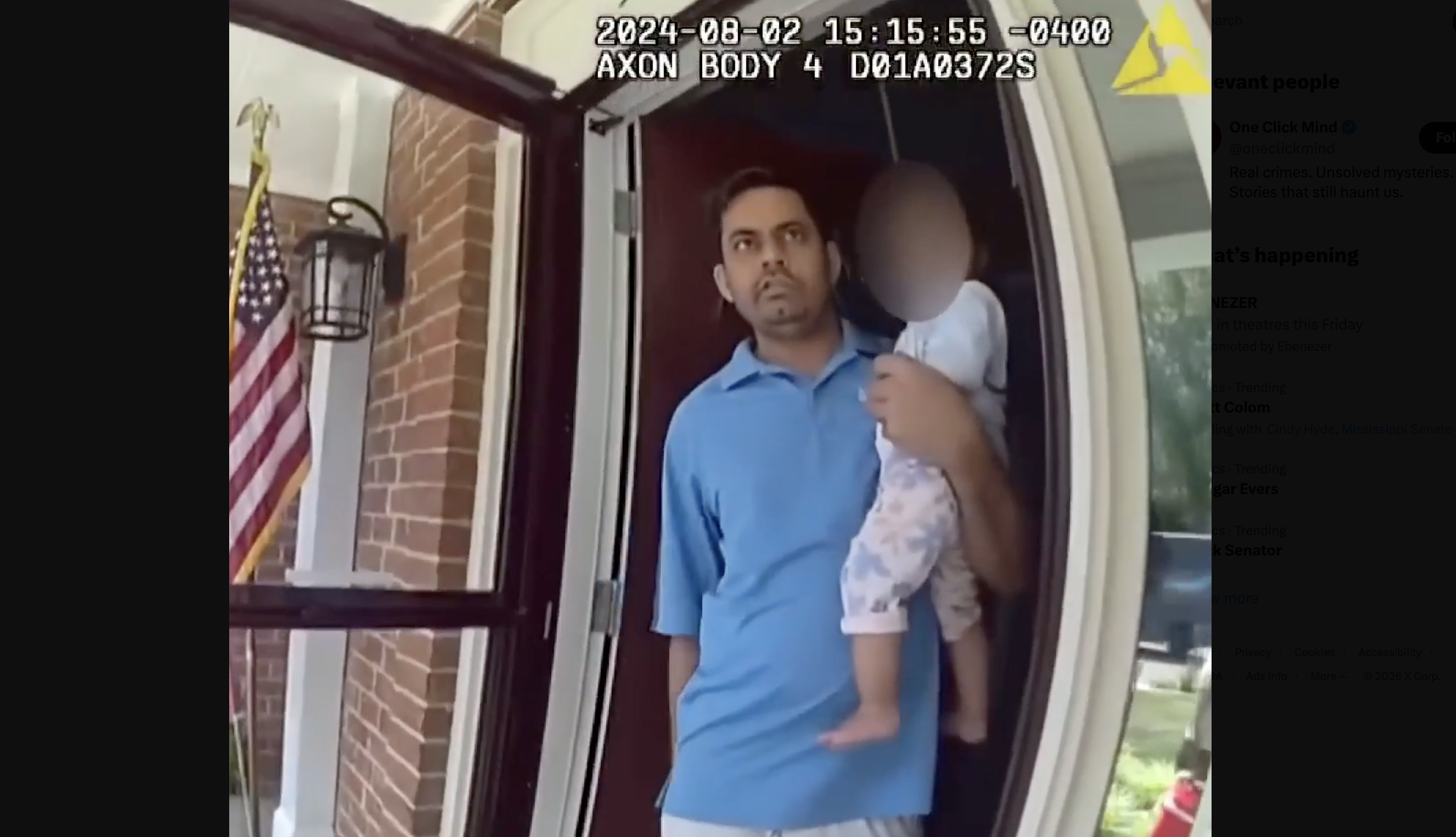
MANASSAS, Va. (Diya TV) — A Virginia jury found Naresh Bhatt guilty Tuesday of first-degree murder, concealing a dead body and defiling a dead body in the disappearance and death of his wife, Mamta Kafle Bhatt. The verdict followed a nearly six-week trial that examined forensic evidence, surveillance footage, digital records and Bhatt’s own testimony.
Bhatt admitted in court that he used a power saw and knives to dismember his wife and dispose of her remains. He denied killing her, however, and testified that she died by suicide. Investigators have never found her body, so they could not determine a medical cause of death.
Bhatt, 39, faces 20 years to life in prison for first-degree murder, plus up to five years for each of the other convictions. The court scheduled his sentencing for March 12, 2027, and revoked his bond after the verdict.
Kafle Bhatt, 28, was a registered nurse at UVA Health Prince William Medical Center in Manassas. Originally from Nepal, she moved to the United States in 2021 after marrying Bhatt. The couple had a young daughter, who was nearing her first birthday when her mother disappeared.
Family and friends grew concerned when Kafle Bhatt stopped contacting them. She regularly video-called her mother in Nepal, often twice a day. Their last known conversation took place July 29, 2024. Kafle Bhatt also stopped posting on social media and missed work. On Aug. 1, colleagues contacted police after she failed to report for scheduled shifts.
During a welfare check the next day, Bhatt told officers that his wife had left and might have traveled to New York or Texas. He initially resisted filing a missing-person report, then reported her missing Aug. 5. Police searched the couple’s home on Aug. 21 and arrested him the following day. Authorities first charged him with concealing a dead body; a grand jury later indicted him on murder and defiling-a-body charges.
Because investigators never recovered Kafle Bhatt’s remains, prosecutors relied on physical and digital evidence to build their case. One key item was a Ryobi reciprocating saw. Evidence showed someone bought the saw, a blade and a battery kit from a Home Depot in June 2024. On Aug. 1, Bhatt gave the saw to a neighborhood landscaper as payment for yard work. The landscaper later turned it over to investigators.
Investigators found reddish-brown stains and hair-like material on the saw. Forensic testing identified DNA profiles on samples from the tool, including material from inside it, that matched Kafle Bhatt. Scientists developed her reference profile using a hairbrush recovered from the home.
Forensic scientists also tested a stained section of carpet from the couple’s bedroom. The results strongly supported that Kafle Bhatt and the couple’s daughter contributed to a DNA mixture found there. The defense challenged what those findings could prove, arguing that the results did not establish how blood reached the carpet or how Kafle Bhatt died. Some other samples from the home produced inconclusive results.
Prosecutors also presented surveillance footage and records tracing Bhatt’s movements after his wife disappeared. Cameras captured him buying cleaning supplies and large trash bags and making trips to dumpsters. Investigators used phone records, vehicle data and license plate information to map trips around Northern Virginia, including visits to trash compactors.
Prosecutors argued that Bhatt used those trips to dispose of his wife’s remains. Bhatt disputed that account, testifying that the discarded bags held her personal belongings. Investigators also recovered internet searches related to a missing spouse, a human brain diagram and a nearby chicken farm on the morning prosecutors said the killing occurred. Prosecutors described the searches as part of a pattern of preparation and concealment; the defense questioned the significance and timing of some digital records.
Bhatt’s testimony became a central part of the trial. He told jurors that he woke around 4 a.m. on July 30, 2024, and found his wife unconscious on the bedroom floor. He said he saw vomit, pill capsules and open pesticide containers nearby. He claimed he tried to revive her for 45 minutes to an hour, then moved her to the bathroom and tried to give her water.
He acknowledged that he never called 911. Bhatt said he panicked and feared authorities would blame him for her death. He testified that he considered suicide, but instead took the couple’s daughter to a babysitter and went to Home Depot to find something he could use to conceal the body.
Bhatt then admitted that he returned home and used a saw and knives to dismember his wife so he could fit her remains into household trash containers. He said he disposed of the remains in trash bags over the following day or so. He maintained that Kafle Bhatt had died by suicide and that he had not killed her.
His account conflicted with what he told police and others after her disappearance. At first, he said she had left home and might have gone to another state. During cross-examination, prosecutor Matthew Sweet asked whether Bhatt had lied to his wife’s relatives, friends, neighbors and police. Bhatt acknowledged that he had. Prosecutors argued that the lies and his later admissions undermined his claim that he acted only out of panic. The jury rejected his account.
Jurors also heard about the couple’s relationship before Kafle Bhatt disappeared. Her brother, Mahesh Kafle, testified that she sent him a photograph showing what appeared to be an injury to her face and had expressed fear about her situation. Other witnesses described marital disagreements and times when Kafle Bhatt stayed away from the family home.
Prosecutors introduced a message Bhatt sent his wife about 162 days before her disappearance: “The days are coming that you will regret a lot.” Senior Assistant Commonwealth’s Attorney Sarah Sami cited the message during closing arguments. The defense disputed the prosecution’s portrayal of the relationship, and Bhatt denied physically abusing his wife.
The case required prosecutors to prove murder without a recovered body, autopsy or confirmed cause of death. They argued that Bhatt put the remains in trash bags that entered the waste system and eventually reached a landfill in Luray, Virginia. Authorities have not recovered them despite extensive searches.
During closing arguments, Sami urged jurors to weigh the evidence together, including the DNA findings, surveillance, digital records, witness accounts and Bhatt’s admissions. The defense argued that the evidence did not prove beyond a reasonable doubt that Bhatt caused his wife’s death. The jury sided with prosecutors.
After the verdict, Kafle Bhatt’s relatives embraced in the courtroom. Friends, former colleagues and members of the local Nepali community gathered outside. Prince William County Commonwealth’s Attorney Amy Ashworth said the verdict brought a measure of justice to a family that had endured more than two years of uncertainty.
Bhatt will remain in custody until sentencing. The verdict resolves the jury trial, but it does not answer where Kafle Bhatt’s remains are or give her family a body to bury. Her family continues to face the possibility that investigators may never find her.


