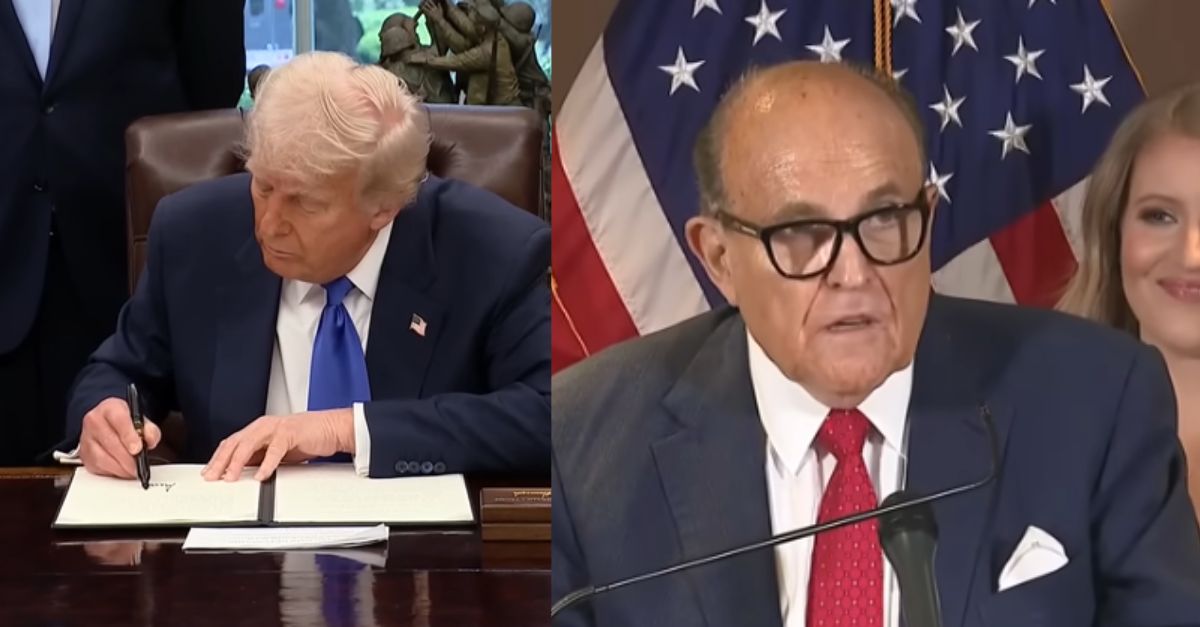
WASHINGTON (Diya TV) — President Donald Trump issued a sweeping wave of pardons Monday for people involved in efforts to overturn his 2020 election loss, a move that reignites debate over one of the most turbulent chapters in modern U.S. politics. The pardons cover several former aides, lawyers, and Republican activists who supported Trump’s bid to challenge the election results.
According to documents posted by U.S. Pardon Attorney Ed Martin, Trump granted clemency to more than a dozen people tied to post-election activities and investigations. The pardons include former Trump allies such as Rudy Giuliani, Mark Meadows, John Eastman, Jeffrey Clark, and others who were charged in the Georgia election interference case.
However, the pardons do not affect state-level prosecutions. Presidential pardons apply only to federal crimes, meaning the Georgia RICO case — which charged Trump and several associates over alleged attempts to overturn the 2020 election results — remains active.
The Georgia case continues to hang over Trump and others involved. Four people who pleaded guilty in that case — attorney Sidney Powell, lawyer Kenneth Chesebro, attorney Jenna Ellis, and businessman Scott Hall — are not affected by Trump’s pardons.
Each accepted a plea deal in 2023, receiving probation, fines, and requirements to publicly apologize. Chesebro and Hall have since had their probation terminated early, court records show. Despite the pardons, those plea agreements stand because they were made in state court, not federal.
Thirteen other defendants in the Georgia RICO case were included in Trump’s pardons. They are Robert Cheeley, Jeffrey Clark, John Eastman, Harrison Floyd, Rudy Giuliani, Misty Hampton, Trevian Kutti, Cathy Latham, Steve Lee, Mark Meadows, Mike Roman, David Shafer, and Ray Smith III.
Trump also extended pardons to a group of so-called “alternate electors” from Georgia — Republican activists who signed false Electoral College certificates claiming Trump won the state. These include Mark Amick, Joseph Brannan, James “Ken” Carroll, Brad Carver, Vikki Townsend Consiglio, John Downey, Carolyn Fisher, Gloria Kay Godwin, David G. Hanna, Mark W. Hennessy, Burt Jones, Daryl Moody, Shawn Still, and C.B. Yadav.
Of those electors, Burt Jones, now Georgia’s lieutenant governor, previously had charges against him dropped after being severed from the case. Latham and Shafer, who were charged, were also part of the Georgia RICO indictment.
The future of the Georgia case remains uncertain. The state investigation faced months of turmoil after the removal of Fulton County District Attorney Fani Willis. A judge disqualified Willis because of her relationship with special prosecutor Nathan Wade, whom she had hired to help lead the case.
The Prosecuting Attorneys’ Council of Georgia now controls the case. The council has until Friday, November 14, to appoint a new prosecutor following a court-approved extension.
In a proclamation released with the pardons, Trump called the prosecutions against his supporters “a grave national injustice.” He said the pardons were meant to continue “the process of national reconciliation” and correct what he described as politically motivated cases.
Trump’s statement portrayed those charged in the 2020 election cases — and participants in the January 6, 2021, Capitol riot — as victims of political persecution. The move reinforces Trump’s ongoing effort to reshape the narrative around the 2020 election and its aftermath as he campaigns for another term in the White House.
While the pardons may not carry immediate legal weight in state-level cases, they send a clear political message. Trump remains focused on defending his actions and those of his allies in the aftermath of the 2020 election.
Legal experts note that federal pardons can erase convictions or pending charges at the federal level, but cannot alter state cases like Georgia’s. That means Trump’s own legal challenges in Georgia — and those of his co-defendants — remain unresolved.
Still, the pardons underscore Trump’s continued influence over his political base and the Republican Party. They also highlight his determination to rewrite the legacy of the 2020 election, portraying it as a battle against what he calls corruption and unfair prosecution.
As the Georgia case waits for a new prosecutor and the 2024 campaign season heats up, Trump’s latest move ensures the debate over the 2020 election — and his role in it — will remain at the center of American politics.