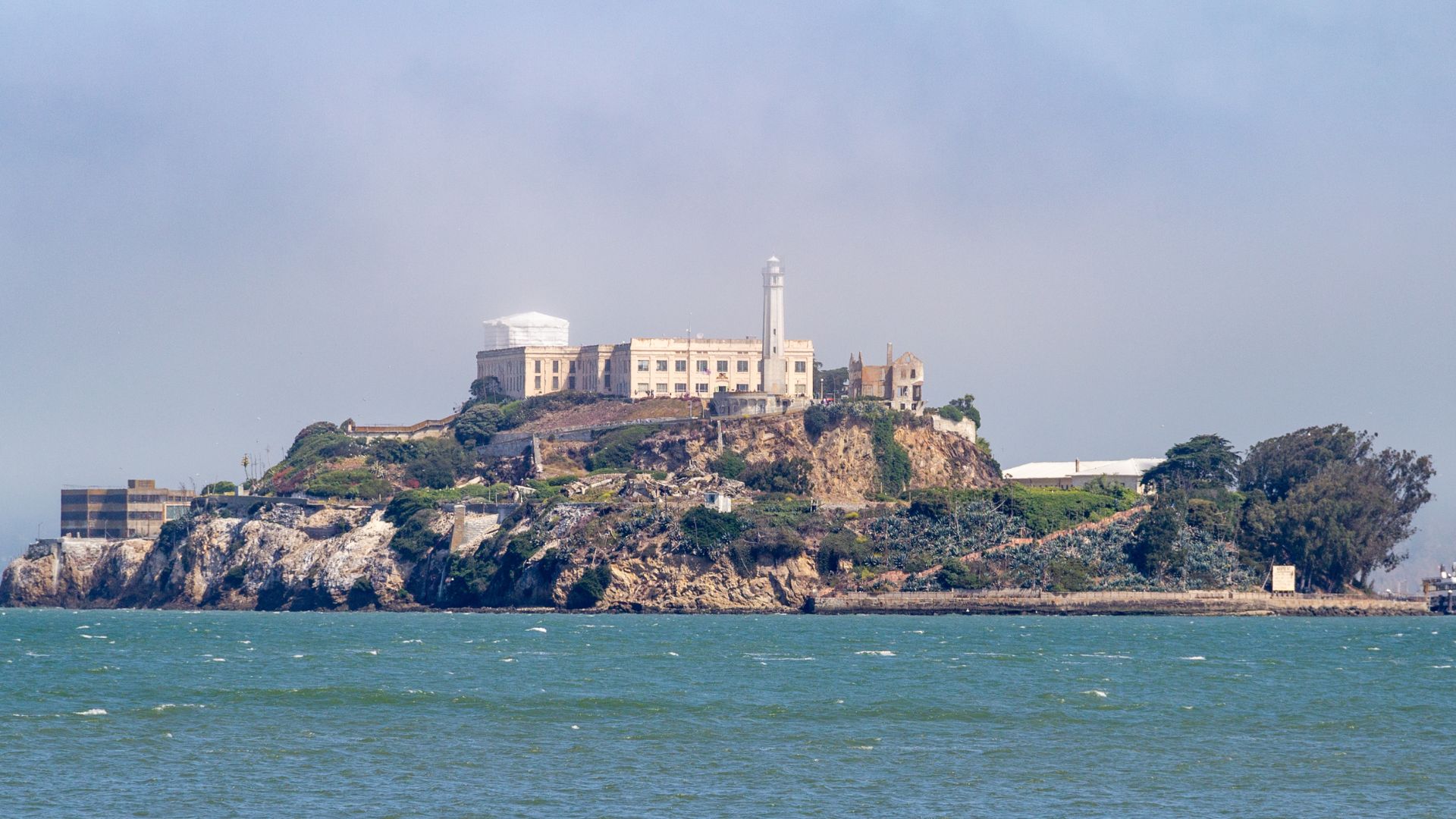
SAN FRANCISCO (Diya TV) — President Donald Trump announced Sunday that he is ordering the reopening and expansion of Alcatraz, the long-shuttered federal prison on an island in San Francisco Bay. The move, which would reverse more than 60 years of Alcatraz’s status as a decommissioned prison and popular tourist destination, has drawn sharp criticism from political leaders, legal experts, and park officials.
Trump made the announcement on his social media platform Truth Social, saying the island will once again house “America’s most ruthless and violent offenders.” He directed the Bureau of Prisons (BOP), the Department of Justice, the FBI, and the Department of Homeland Security to oversee the reopening and reconstruction of the site. “The reopening of Alcatraz will serve as a symbol of Law, Order, and Justice,” Trump wrote.
The former president tied the announcement to concerns about violent crime and what he described as “radicalized judges” who have resisted his calls for mass deportations. Speaking to reporters Sunday, he criticized the judicial system for what he called an “absurd” requirement to give trials to undocumented immigrants: “That would mean millions of trials. It’s so ridiculous what’s happening,” he said.
Trump’s announcement arrives amid legal controversy over his administration’s reported attempts to send accused gang members to prisons in El Salvador, despite objections from U.S. courts. Some judges and members of Congress have raised concerns about due process violations in those deportations.
Alcatraz, also known as “The Rock,” operated as a federal prison from 1934 until 1963. It famously housed notorious criminals such as Al Capone and George “Machine Gun” Kelly. The prison was closed due to high maintenance costs and logistical challenges. According to the Federal Bureau of Prisons, Alcatraz was nearly three times more expensive to operate than other federal prisons, with a daily per-inmate cost of $10.10 in 1959.
In 1972, Congress added Alcatraz to the Golden Gate National Recreation Area, and it has since become a major tourist attraction managed by the National Park Service. More than 1 million people visit the island annually. The site is also a designated National Historic Landmark.
California officials have pushed back forcefully. “This is just distraction day again in Washington, D.C.,” a spokesperson for Gov. Gavin Newsom said in a statement. State Sen. Scott Wiener (D-San Francisco) called the plan a “crusade to sabotage the rule of law,” warning it would convert a historical landmark into a “domestic gulag.” Former House Speaker Nancy Pelosi, whose district includes Alcatraz, echoed that sentiment. “It is now a very popular national park and major tourist attraction. The president’s proposal is not a serious one,” Pelosi wrote on X.
Legal and logistical questions also surround the plan. The island’s infrastructure has deteriorated since its closure, and it remains under National Park Service control. A Bureau of Prisons spokesperson told the Associated Press the agency “will comply with all presidential orders” but declined to elaborate on the practicality or feasibility of restoring the site for correctional use.
Alcatraz’s location—cut off by cold, turbulent waters—made it nearly inescapable, and it remains ingrained in American culture through films like Escape from Alcatraz and The Rock. Yet the island is also a symbol of protest; Indigenous activists occupied it for 19 months starting in 1969, claiming it as land promised in 19th-century treaties.
Whether Trump’s directive moves forward remains uncertain. As of Sunday night, the National Park Service and other federal agencies had not confirmed any operational changes to the site. Still, Trump’s supporters herald the move as a bold stance on crime, while critics call it a political stunt with little chance of implementation.