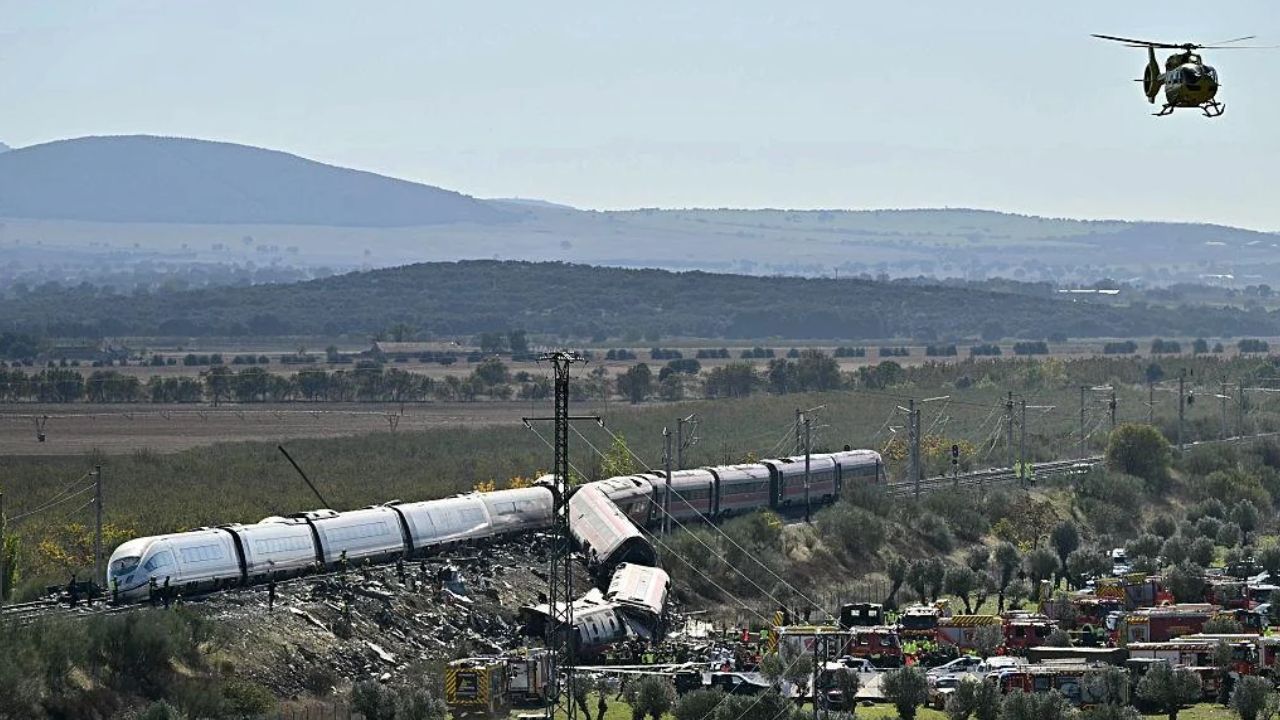
URDA, Spain (Diya TV) — Spain began three days of national mourning Thursday after a collision near Urda, in Toledo province, killed 69 people and injured 110. Fifty people remained in hospitals, including 15 in critical condition, regional officials said. Search teams continued working through the wreckage as families waited for authorities to identify victims.
The crash happened at 8:53 a.m. Wednesday on the Madrid–Seville high-speed line. A Renfe train struck the rear of an Iryo train that had stopped near Urda. Iryo said its train carried 147 passengers and crew; regional emergency officials said the Renfe train carried 393 passengers. The impact derailed several cars, some of which slid down a gravel embankment.
Rescuers used cranes, search dogs and heavy equipment to reach damaged carriages and recover victims. The Guardia Civil received 64 reports by Thursday morning from people searching for missing relatives. Officials said they were collecting DNA samples from close family members to help identify victims.
Investigators are focusing on a signaling failure and the orders that followed. Transport Minister Óscar Puente said a computer malfunction disrupted the LZB safety system, stopping six trains on the line. Adif’s control center then instructed trains to resume service. Investigators are examining why the Renfe train received permission to proceed at normal speed while the Iryo train remained stopped ahead.
The Iryo driver reportedly told the control center that the train could not restart the LZB system and remained stopped at a signal. The Renfe train nevertheless continued toward it. Investigators will review train data recorders, control-center audio, phone calls and movement logs to reconstruct what each operator knew and when. A judge has ordered officials to preserve evidence at the scene.
Officials have not established the cause or assigned responsibility. The rail safety authority briefly posted a preliminary toll of 74 deaths, then corrected it to 69; regional authorities said 69 remained the official count. That discrepancy underscored the difficulty of confirming casualties while teams continued searching the wreckage.
The crash has disrupted travel between Madrid and Andalusia. Adif suspended high-speed service on the affected corridor, while Renfe arranged replacement journeys on conventional tracks between Madrid, Ciudad Real and Puertollano. Those trips take about 90 minutes longer. Renfe and Iryo opened family assistance centers and hotlines, and Renfe said it planned a broader alternative transport service from Friday.
This is Spain’s second deadly high-speed rail crash this year. A January collision in the south killed 46 people. The two disasters have shaken confidence in a network that Spain has expanded for decades and long treated as a symbol of modern infrastructure. Rail unions have urged investigators to examine the system’s procedures and safeguards, not only the decisions of individual staff.
Prime Minister Pedro Sánchez promised a full investigation and stronger safety measures. The government now faces two urgent tasks: support survivors and families while determining how a train could resume normal-speed travel with another service stopped ahead. The findings will shape whether Spain changes its control procedures, technical safeguards or both.