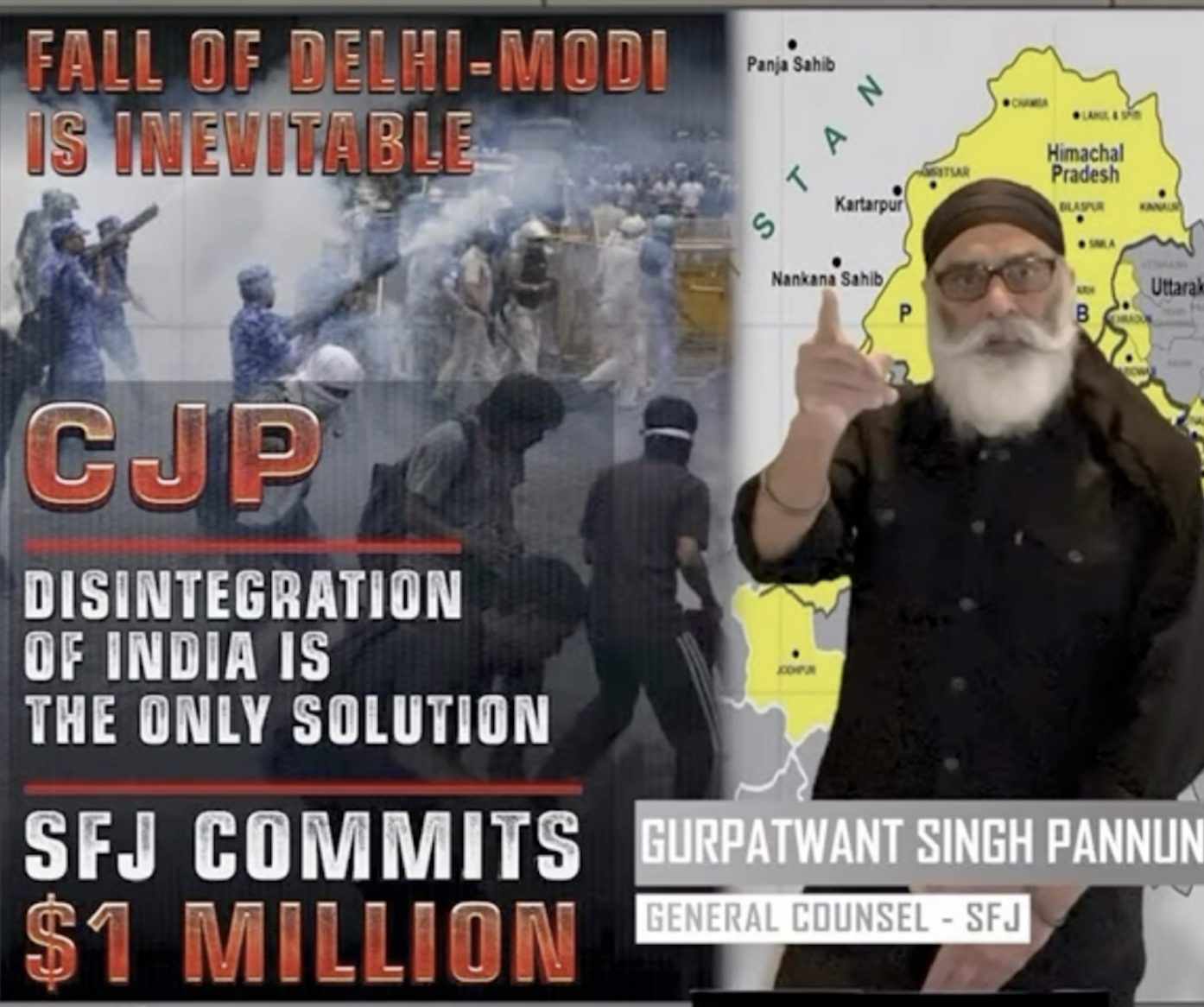
NEW DELHI (Diya TV) — India-banned Khalistani separatist organization Sikhs for Justice has pledged $1 million to the Cockroach Janta Party movement while calling for the “dissolution, disintegration, and Balkanization of India,” urging protesters to refuse negotiations with Indian Prime Minister Narendra Modi’s government and continue their agitation through India’s Independence Day.
But buried within SFJ leader Gurpatwant Singh Pannun’s declaration was another significant detail.
“As presented in our Zoom meeting,” Pannun said, “the only real solution for the youth is the ‘Dissolution, Disintegration, and Balkanization of India.’”
Pannun later reiterated the $1 million commitment while again referring to what had been stated during the Zoom meeting.
SFJ’s statement does not identify the participants in that meeting. But its own wording indicates that the organization’s $1 million pledge and its proposal for the breakup of India had already been presented in a Zoom discussion before being announced publicly.
That raises an immediate question surrounding a protest movement operating in the heart of the Indian capital: Who participated in the meeting with SFJ, and what exactly was discussed?
The question is particularly significant because SFJ is not simply another overseas advocacy organization.
The Indian government has formally declared Sikhs for Justice an unlawful association under the Unlawful Activities (Prevention) Act. SFJ remains on the Ministry of Home Affairs’ current list of unlawful associations, while Pannun has separately been designated an individual terrorist under Indian law.
The announcement therefore brings together three elements: an India-banned separatist organization, a claimed prior Zoom meeting and a proposed $1 million financial commitment to a mass political protest movement inside India.
SFJ has attached an explicitly separatist program to that commitment.
It wants protesters to refuse negotiations with the Modi government, have demonstrations continue through August 15, while rejecting that date as India’s Independence Day.
They have called for action surrounding Modi’s traditional Independence Day appearance at the Red Fort and describes the “dissolution, disintegration, and Balkanization of India” as the “only real solution” for Indian youth. SFJ’s own published message contains both the $1 million announcement and the reference to the Zoom meeting.
The word “Balkanization” is central to understanding what SFJ is proposing.
It describes the fragmentation of a larger state into smaller political entities. In SFJ’s formulation, the objective extends beyond its longstanding campaign to carve Khalistan out of Indian territory. Pannun is explicitly speaking of the wider “dissolution” and “disintegration” of India itself.
This is the organization now seeking to attach $1 million to a movement that entered the national spotlight under the banner of Indian students.
What initially started as a protest centered on youth grievances and problems within India’s education and examination systems has rapidly expanded into a much wider political arena. The CJP movement emerged in 2026 as a satirical political movement and has since become the organizing force behind major demonstrations in Delhi. Its own website describes CJP as a political and satirical movement rather than a conventional electoral party.
CJP itself explicitly states in its legal disclaimer that it is “not a registered political party” and does not contest elections. The Election Commission of India separately maintains the framework through which political parties formally register under Section 29A of the Representation of the People Act.
Yet the movement surrounding CJP has grown far beyond satire.
Its demonstrations have drawn thousands into the streets and evolved from demands centered on students and examinations into a broad confrontation with the government.
The protest platform has also increasingly accommodated issues that have virtually nothing to do with examination reform.
At the CJP protest in Delhi, demands surrounding the restoration of Article 370 and Jammu and Kashmir’s constitutional status have entered the political environment surrounding the demonstrations. The issue moves the protest conversation from student examinations into one of the most sensitive questions concerning India’s constitutional and territorial structure.
The common thread running through the causes now appearing around the movement is no longer examination reform. It is a widening challenge to the Indian state — its government, its constitutional arrangements, its national symbols and, in SFJ’s case, its territorial existence itself.
The claimed Zoom meeting adds an entirely different dimension.
Under Section 10 of the UAPA, once an association has been declared unlawful, Indian law provides penalties for a person who takes part in meetings of that association, contributes to or receives contributions for its purposes, or otherwise assists its operations. The provision carries imprisonment of up to two years and a fine. The law makes the identities of those involved in any meeting with SFJ potentially significant.
That does not mean that the mere appearance of someone on any call automatically establishes an offense. But SFJ’s own declaration now places the existence and purpose of the claimed Zoom meeting squarely within the public interest.
CJP describes itself as an Indian political and satirical movement but expressly says it is not a registered political party. Its legal status matters because India tightly regulates foreign contributions to political activity.
Under the Foreign Contribution Regulation Act, political parties and their officeholders are prohibited from receiving foreign contributions. Organizations formally determined by the central government to be “of a political nature” are also among those prohibited from receiving foreign contributions.
CJP’s lack of Election Commission registration therefore does not by itself settle the question of how Indian authorities would treat a proposed $1 million foreign contribution connected to its political protest activities.
The source of the proposed funding makes the issue still more significant: the money is being publicly pledged by an organization that India has already banned under the UAPA.
SFJ’s announcement itself does not establish that money has changed hands. But the pledge, the claimed Zoom meeting and the political conditions attached to the money create obvious grounds for scrutiny of any attempted transfer, its intended recipient and its ultimate use.
There is also the question of separatist advocacy itself.
Section 152 of the Bharatiya Nyaya Sanhita applies to anyone who purposely or knowingly, including through electronic communication or financial means, excites or attempts to excite secession, encourages separatist activities or endangers the sovereignty, unity and integrity of India. The offense can carry imprisonment for life or a term of up to seven years, along with a fine.
The UAPA separately criminalizes certain forms of participation in and advocacy of unlawful activity, including activity connected to the cession or secession of Indian territory.
Against that legal framework, Pannun’s language is unusually explicit.