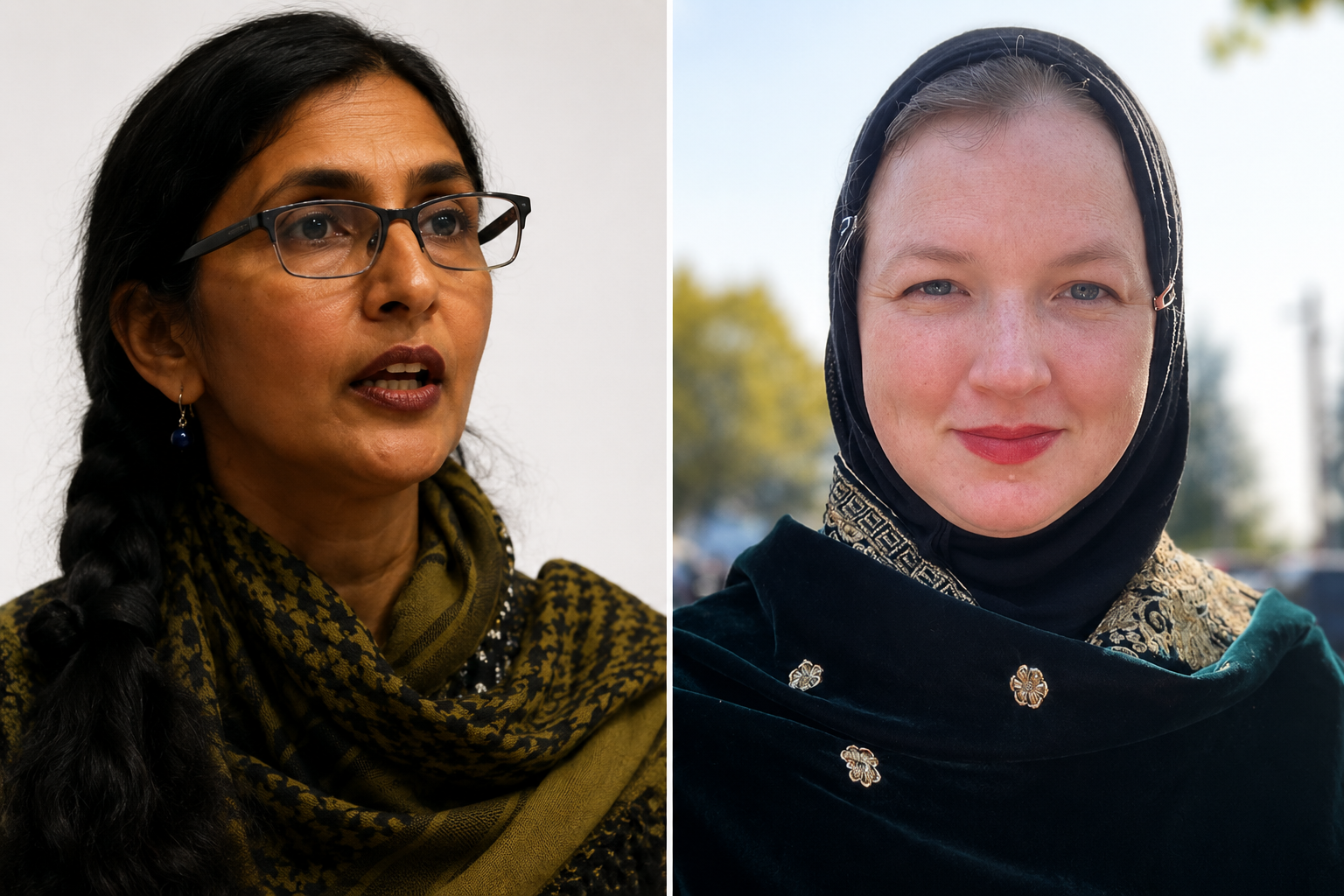
Longtime Democratic Rep. Adam Smith won a majority of the initial vote, while Republican Doug Basler secured the second general-election position ahead of Indian American socialist Kshama Sawant and Democratic challenger Melissa Chaudhry.
SEATTLE (Diya TV) — Democratic U.S. Rep. Adam Smith and Republican Doug Basler advanced from Washington’s 9th Congressional District primary Tuesday, defeating Indian American socialist Kshama Sawant and Democratic challenger Melissa Chaudhry in a race that tested whether opposition to U.S. support for Israel, revolutionary socialism and frustration with the Democratic establishment could dislodge one of Washington’s longest-serving members of Congress.
Smith received 36,070 votes, or 50.9 percent, in the initial count released by King County Elections. Basler placed second with 16,842 votes, or 23.8 percent. Sawant finished third with 8,896 votes, or 12.6 percent, followed by Chaudhry with 8,083 votes, or 11.4 percent. Socialist Workers Party candidate Jacob Perasso received 802 votes, or 1.1 percent. Smith and Basler were projected to advance to the Nov. 3 general election.
Washington uses a top-two primary in which every candidate appears on the same ballot and the two highest vote-getters advance regardless of party preference. The system does not select separate Democratic and Republican nominees. Basler therefore needed only to finish ahead of Sawant and Chaudhry to secure a place in November, even though the district has consistently elected Democrats by wide margins.
Smith’s outright majority placed him more than 19,000 votes ahead of Basler. Basler led Sawant by 7,946 votes and Chaudhry by 8,759. Sawant and Chaudhry together received 16,979 votes, only 137 more than Basler, but neither candidate independently approached the second-place position required to advance.
The initial report covered 71,932 ballots cast by 454,460 registered voters within the congressional contest, producing turnout of 15.8 percent. Washington conducts elections primarily by mail, and properly postmarked ballots can continue arriving after Election Day. King County plans to update results on weekdays through certification. County canvassing boards are scheduled to certify the primary Aug. 18, and the secretary of state faces an Aug. 21 certification deadline.
The result set up a sixth general-election contest between Smith and Basler. The two previously faced each other in 2014, 2016, 2018, 2020 and 2022, with Smith winning each race. Smith defeated Basler 171,746 votes to 67,631 in their most recent contest, receiving 71.6 percent of the 2022 vote.
The primary also produced a clear contrast between fundraising and electoral performance. Sawant reported raising $645,401 and spending $607,494 through July 15. Every dollar listed as a contribution came from individuals. Her campaign entered the final weeks with $37,908 in cash and $19,853 in debts. Sawant raised more than six times Basler’s total but received barely half as many votes.
Basler reported $99,242 in receipts and $94,764 in spending. Of his campaign’s contributions, $72,000 came from Basler himself and $26,482 came from other individuals. His campaign reported $5,021 in cash on hand.
Smith maintained the largest financial operation in the field. His campaign reported $1.88 million in receipts, including $1.32 million from individuals and $563,000 from other political committees. It spent $1.58 million and reported $869,549 in cash on hand as of July 15. Chaudhry reported $30,073 in receipts, $65,585 in spending and $67,155 in cash on hand.
The district stretches across King County and includes portions of Seattle and Bellevue along with Mercer Island, Tukwila, SeaTac, Renton, Kent, Auburn, Des Moines and Federal Way. It is one of the state’s most diverse and immigrant-heavy congressional districts. Census estimates place its population at approximately 776,000, with 33.5 percent of residents born outside the United States and nearly 42 percent speaking a language other than English at home.
Smith has represented the district since January 1997 and is the longest-serving current member of Washington’s House delegation. He entered Congress after serving in the Washington Senate from 1991 through 1996 and working as a Seattle prosecutor. He has served on the House Armed Services Committee throughout his congressional career, chaired it during the 116th and 117th Congresses and currently serves as its ranking Democrat.
His 2026 campaign emphasized the institutional influence built through nearly three decades in Congress. Smith pointed to federal funding for affordable housing, transit, workforce training, airport-noise mitigation and environmental projects throughout King County. He also presented himself as a Democratic check on President Donald Trump and placed affordability at the center of his campaign message.
Smith’s housing program called for expanded construction near transit, federal incentives for local zoning and permitting changes and restrictions on large investment firms buying single-family houses. He has sponsored legislation that would require private-equity firms to divest those properties and prohibit future bulk purchases. His campaign also cited legislation that helped make transit-owned land available for affordable housing development.
On labor and economic policy, Smith supported raising the federal minimum wage to $20 an hour, strengthening collective-bargaining protections, expanding apprenticeship and technical-college programs, creating national paid family leave and reducing child-care costs. He also backed a universal health care system, restrictions on congressional stock trading and a tax on high-volume Wall Street transactions.
Sawant offered the most direct ideological challenge to Smith. She did not run as a Democrat attempting to move the party leftward. She ran as an independent revolutionary socialist calling for the defeat of both major parties and the creation of a new workers’ party. Her campaign described the election as a confrontation with billionaires, defense contractors, AIPAC and the Democratic and Republican political establishments.
Sawant’s congressional candidacy also marked the latest stage of a political career shaped by her Indian American background. Born in Pune, India, and raised in Mumbai, Sawant earned a bachelor’s degree in computer science from the University of Mumbai before moving to the United States. She later earned a doctorate in economics from North Carolina State University, taught economics in the Seattle area and became a U.S. citizen in 2010.
She entered Seattle politics through the socialist movement and won a City Council seat in 2013, becoming the first socialist elected to the body in more than a century. She served from 2014 through 2023 and became one of the country’s most nationally recognizable socialist officeholders.
Sawant’s Indian background became especially prominent during her final year on the council when she sponsored legislation adding caste to Seattle’s anti-discrimination code. The ordinance extended the city’s employment, housing, public-accommodation and contracting protections to discrimination based on caste. It passed 6-1 on Feb. 21, 2023, and received mayoral approval two days later, making Seattle the first U.S. city to enact an explicit caste-discrimination prohibition.
The measure exposed sharp divisions within the Indian American and broader South Asian community. Dalit-led organizations argued that explicit protection was necessary because caste discrimination persisted in employment, housing, education and the technology industry. A number of Hindu American organizations opposed the ordinance, arguing that it singled out South Asians and could encourage discrimination against Hindus. Sawant rejected that argument and said caste discrimination crossed religious and national boundaries.
Meanwhile, as of publication, Seattle’s publicly available records identify no caste-discrimination complaint or enforcement action since the ordinance took effect.
Her City Council tenure also included the campaign for Seattle’s $15 minimum wage, the city’s payroll tax on large corporations and restrictions on landlords. Sawant backed limits on late fees, expanded notice requirements for rent increases and protections against certain winter and school-year evictions. She survived a 2021 recall election by 310 votes, declined to seek another council term in 2023 and later left Socialist Alternative to establish Revolutionary Workers.
Sawant carried that record into a congressional platform substantially to the left of Smith and the national Democratic Party. She called for a $25 federal minimum wage, a 30-hour workweek without reduced pay, cancellation of student and medical debt, a federally financed living-wage jobs guarantee and national rent control.
Her housing platform proposed limiting annual rent increases, constructing publicly owned housing and placing major real estate corporations and banks under public ownership. Her health care plan called for eliminating the private insurance industry, establishing a fully government-operated system and bringing major pharmaceutical companies and hospitals into public ownership.
Sawant also called for public ownership of major technology, artificial intelligence and energy companies. She proposed stopping new artificial intelligence data centers, ending tax incentives for automation and guaranteeing government-funded jobs to workers displaced by artificial intelligence. Her campaign framed those proposals as a direct challenge to Amazon, Microsoft and other large corporations with deep economic ties to the Seattle region.
On immigration, Sawant advocated abolishing Immigration and Customs Enforcement, closing federal immigration detention centers, ending deportations and providing government-funded legal representation to immigrants facing removal. Her campaign called for protests, civil disobedience and labor action to obstruct immigration enforcement operations.
The Israel-Hamas war occupied a central position in Sawant’s campaign. She demanded an end to all U.S. military assistance to Israel, a permanent arms embargo and support for the boycott, divestment and sanctions movement. Her platform endorsed what it called the Palestinian right to resist “with force” and said Israel’s existing political and economic system “must be smashed” and replaced by a socialist society with equal rights for Israelis and Palestinians. Those positions came directly from Sawant’s published campaign platform.
Sawant also opposed U.S. assistance to Ukraine and characterized the war there as an inter-imperialist proxy conflict. Her foreign policy called for an organized antiwar movement capable of conducting strikes and other mass action against U.S. military involvement overseas.
None of those proposals produced enough districtwide support to place Sawant in the general election. Her 12.6 percent left her more than 38 percentage points behind Smith and more than 11 points behind Basler despite the campaign’s extensive fundraising and Sawant’s decade in elected office.
Sawant blamed Chaudhry for dividing voters who opposed Smith. Speaking to approximately 50 supporters at the Casa Latina worker center on election night, Sawant criticized Chaudhry’s decision to enter the race.
“Shame on Melissa Chaudhry,” Sawant said.
The initial results supported Sawant’s narrow mathematical argument about the second general-election position: the combined Sawant-Chaudhry vote exceeded Basler’s total by 137 votes. It did not support a broader claim that an undivided left-wing campaign was close to defeating Smith. Their combined total remained 19,091 votes behind the incumbent.
Chaudhry entered the race seeking a rematch with Smith after advancing alongside him from the 2024 primary. With no Republican qualifying for that year’s general election, voters chose between two candidates identifying as Democrats. Smith won the 2024 contest with 182,780 votes, or 65.4 percent, while Chaudhry received 90,601 votes, or 32.4 percent.
Chaudhry’s connection to Pakistan runs through her husband, Muhammad Zahid Chaudhry, a Pakistan-born legal permanent resident and former U.S. Army service member. Her 2026 campaign placed his immigration case at the center of its constitutional and civil-liberties message.
Zahid Chaudhry was detained by ICE on Aug. 21, 2025, when he appeared for a scheduled citizenship interview in Tukwila. He remained in federal custody for 124 days, including time in solitary confinement, before a federal judge ordered his release. Campaign materials state that he was honorably discharged from the Army in 2005 after sustaining injuries on active duty and later worked as a firefighter, paramedic and first responder.
The Department of Homeland Security said Zahid Chaudhry had failed to disclose an Australian criminal record when applying for U.S. immigration benefits and had misrepresented his citizenship while seeking a reserve police position. Melissa Chaudhry rejected the agency’s account, described its public statements as a smear campaign and argued that his detention violated due-process protections. She later published a book, “Service and Sacrifice,” about his military service and immigration case.
Chaudhry publicly identifies as Muslim and has described her faith as a reason for participating in public life. Her campaign emphasized constitutional rights, immigrant protections, housing, health care, economic support for families and limits on presidential war-making authority. Her public record supports describing her as a Muslim, pro-Palestinian and antiwar candidate. It does not establish a factual basis for describing her as an Islamist.
Her economic platform called for expanding affordable housing, protecting renters, restricting large investment firms’ purchases of residential property, raising wages, strengthening unions and expanding child care, public education, health care, elder care and disability services. She supported universal health care and proposed ending the connection between employment and health insurance.
Chaudhry also called for greater oversight of ICE and the Department of Homeland Security, stronger due-process protections in immigration proceedings and opposition to federal contracts with Palantir and other companies providing surveillance and data systems to immigration authorities. Her foreign policy favored diplomacy, congressional control over military action, audits of Pentagon spending and shifting money from defense contractors toward infrastructure, veterans’ services and domestic programs.
On Israel and Gaza, Chaudhry accused Israel of war crimes, opposed continued U.S. support for its military campaign and pledged not to accept donations from defense contractors or organizations she considered connected to foreign interests. She rejected AIPAC support and presented Smith’s Armed Services Committee leadership and defense-industry contributions as central reasons to replace him.
Her campaign encountered a late controversy during an on-the-record endorsement interview with The Stranger. Chaudhry said she had omitted an explicit LGBTQ+ position from her campaign website because “a lot of Muslims do not feel that way.” She also said her personal plan, if elected as a Democrat, was to switch to the Green Party while serving in Congress.
The Washington Stonewall Democrats urged political organizations to reconsider their support. Chaudhry later said the interview was one of the least-proud moments of her life, affirmed her support for equal legal rights and pointed to her past involvement in a high school Gay-Straight Alliance and her relationships with LGBTQ+ relatives and friends. Her website subsequently included a stated commitment to LGBTQ+ equality.
Basler’s second-place finish returned the district to a conventional Democratic-Republican general election. A small-business owner and media producer, Basler previously served as vice chairman of the King County Republican Party and president of the Eastside Republican Club. His community work has included youth ministry, church service and homelessness outreach.
Basler ran on affordability, public safety, lower taxes, support for private employers and opposition to Sawant’s socialist program. He argued that taxes, regulations and Washington’s Climate Commitment Act had contributed to higher fuel, food, housing and energy costs. He also warned that hostility toward major Seattle-area employers could reduce investment and employment.
Preventing Sawant from advancing became a central argument of Basler’s campaign. He contended that a Smith-Sawant general election would leave Republican and center-right voters without a candidate while giving Sawant a larger platform for public ownership, abolishing ICE, restricting private property and ending support for Israel. The initial count placed Basler comfortably ahead of both Sawant and Chaudhry despite his smaller campaign operation.
Basler now faces the same political structure he confronted in his five previous races against Smith. The district gave Smith more than 71 percent against Basler in 2022 and more than 65 percent against Chaudhry in 2024. Its large immigrant population, organized labor presence, urban and suburban Democratic base and Smith’s long-established political operation have repeatedly produced decisive Democratic victories.
Tuesday’s primary gave Smith more votes than any two of his opponents combined. Sawant raised the second-largest sum in the race and offered the most sweeping socialist platform. Chaudhry returned after receiving more than 90,000 votes two years earlier and built her campaign around constitutional rights, her husband’s immigration case and opposition to American military policy. Basler spent less than either Smith or Sawant and nevertheless secured the only position that allowed a challenger to continue.
Smith emerged with a majority, the Republican advanced, and the two campaigns seeking to replace the Democratic incumbent from his left ended in third and fourth place.