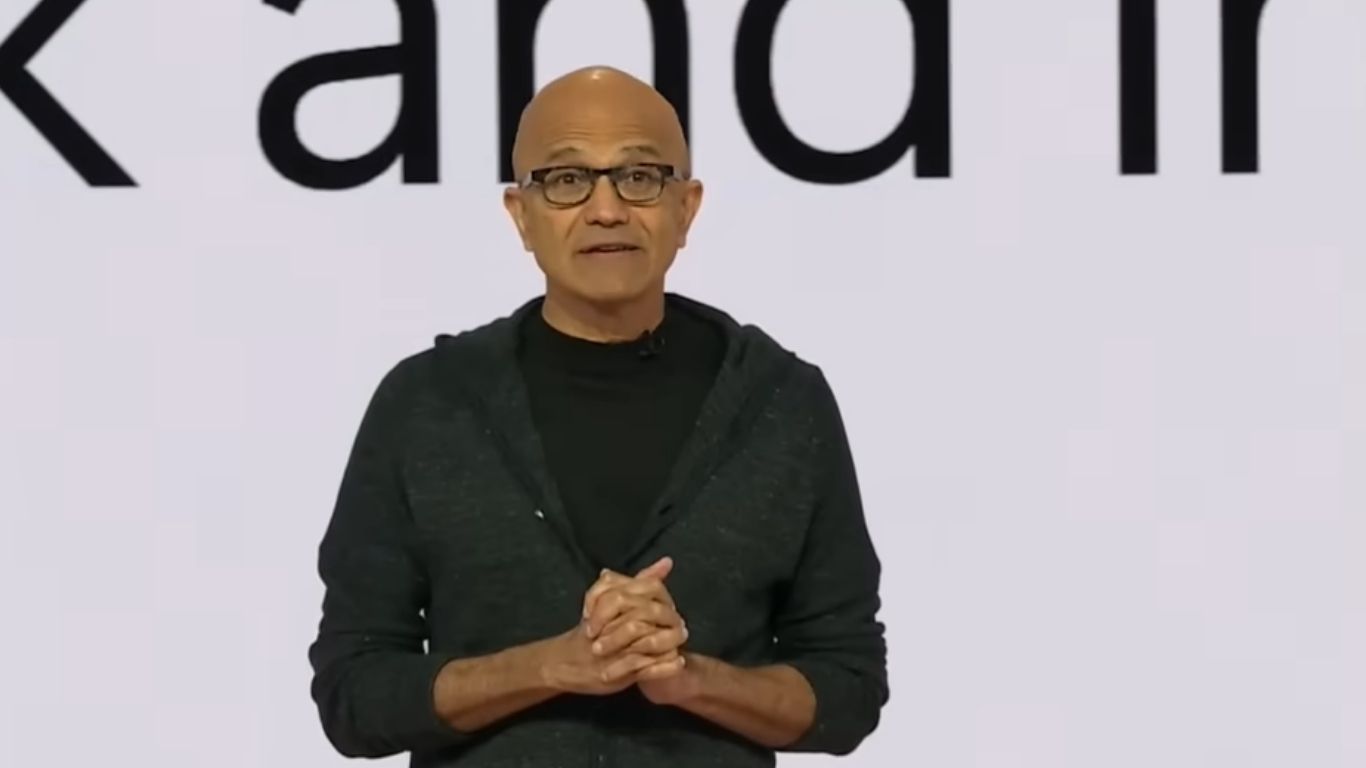
REDMOND, Wash. (Diya TV) — Microsoft CEO Satya Nadella has warned that businesses face a growing risk as they adopt artificial intelligence. While AI helps companies work faster and smarter, it may also collect valuable business knowledge over time. Nadella described this challenge as the “Reverse Information Paradox” in a post on X on Sunday.
He said companies now pay for AI in two ways. First, they pay money to access advanced AI models. Then, they also share their own expertise through prompts, corrections, and daily interactions. As a result, AI systems improve while learning from users. Meanwhile, businesses often gain little insight into what AI providers learn in return.
Nadella based his argument on Nobel Prize-winning economist Kenneth Arrow’s well-known “Information Paradox.” Arrow argued that information loses some of its value once someone reveals it. In other words, a buyer must see the information before knowing its worth. However, after seeing it, the buyer already has access to it.
According to Nadella, AI creates the opposite problem. Instead of buyers gaining more knowledge, AI providers steadily learn from their customers. Therefore, the balance of information shifts over time. Companies share valuable insights through prompts, edits, and feedback. Yet they rarely know how much those interactions improve future AI systems.
Nadella said this issue goes far beyond data privacy. Instead, he believes companies should focus on protecting their institutional knowledge. He explained that AI models learn from prompts, agent workflows, evaluation methods, and user corrections. Every time employees fix an AI-generated mistake, they add valuable knowledge to the system. Over months or years, those improvements may reflect years of business experience.
He argued that this knowledge has enormous value because competitors cannot easily copy or purchase it. However, companies may give away that advantage without realizing it. Each interaction may seem small. Still, those small pieces can add up over time. As a result, businesses may lose part of the expertise that makes them unique.
“In consuming intelligence, you are creating intelligence,” Nadella wrote. He added that organizations should own the intelligence they help create through their everyday work with AI systems.
Nadella also said AI companies should continue training models on publicly available information. However, he questioned a business model where AI providers learn from customer interactions while limiting customers from distilling or adapting models for their own use. He argued that this creates an uneven exchange. Consequently, AI infrastructure owners could capture more of the long-term economic value than the businesses generating the knowledge.
Furthermore, Nadella said enterprises need what he called a “trust boundary.” He described it as a secure environment where a company’s data, AI memory, evaluation results, adapted models, and work history remain under its control. Such a system would allow organizations to improve AI tools while protecting their own intellectual assets.
To reduce these risks, Nadella outlined five guiding principles for enterprise AI adoption. First, companies should keep control of their data and institutional knowledge. Second, they should create private environments where AI systems learn only from internal information. Third, businesses should avoid relying on just one AI model or provider. Fourth, they should use flexible AI infrastructure to improve efficiency and manage costs. Finally, they should build continuous learning systems that strengthen their AI investments over time instead of transferring that value elsewhere.
The debate comes as companies across industries continue expanding AI use in customer service, software development, healthcare, finance, manufacturing, and education. Many organizations already depend on AI assistants to write reports, analyze data, generate code, and automate routine tasks. Therefore, questions about data ownership, intellectual property, and long-term control have become increasingly important.