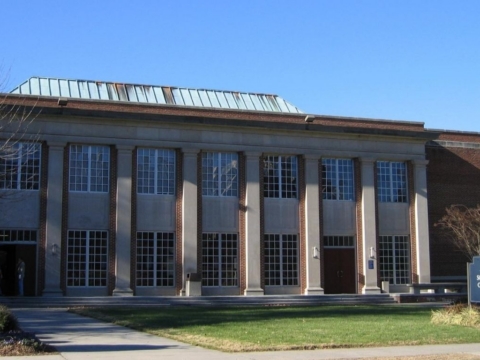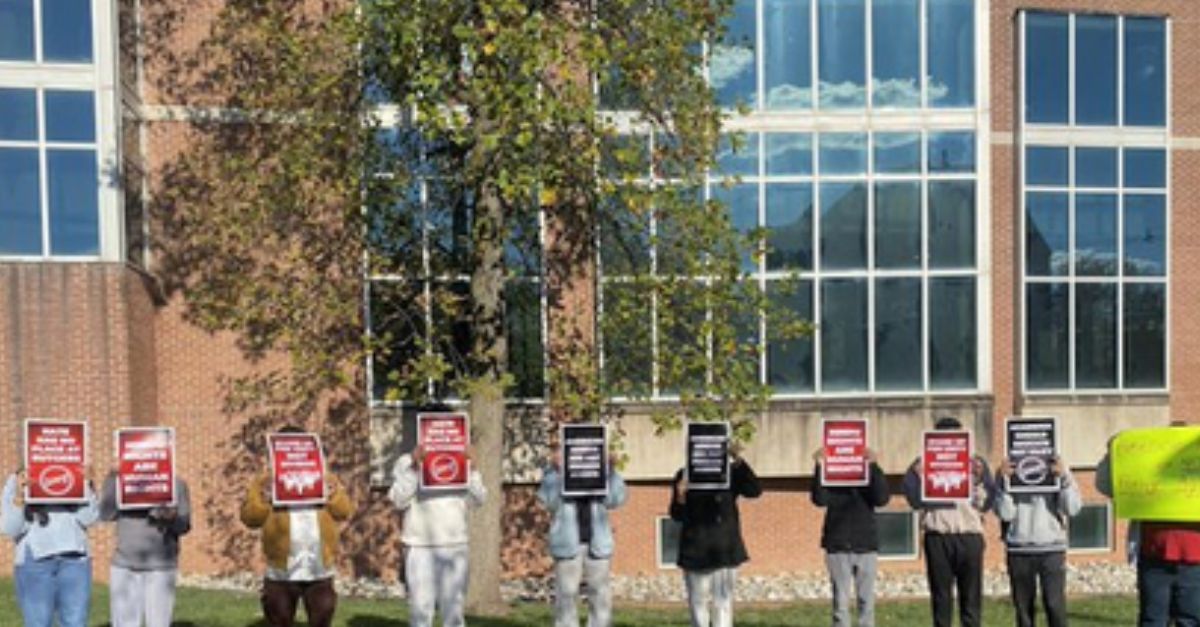
NEW BRUNSWICK, N.J. (Diya TV) — A silent protest broke out at Rutgers University on Oct. 27 as students, faculty, and community members gathered in front of Alexander Library to oppose a lecture hosted by the Rutgers Center for Security, Race and Rights (CSRR). The event, titled “Hindutva in America: A Threat to Equality and Religious Pluralism,” examined the rise of Hindu nationalism and its alleged influence in the United States.
The lecture, moderated by Rutgers Law School professor Sahar Aziz, featured historian Audrey Truschke as the expert speaker. Truschke, who teaches history and Asian studies at Rutgers University–Newark, discussed how far-right Hindu nationalism, or Hindutva, has affected Muslim American communities.
At the same time, members of the student-led Hindu advocacy group Rutgers CYAN staged a peaceful protest outside. The group criticized CSRR for publishing a June report that they say unfairly links Hindu student organizations to extremist movements.
“The main reason and basis of our protest was that we were standing up against the labeling of Hindu student organizations at Rutgers as extremist groups,” a Rutgers CYAN member told The Daily Targum.
The CSRR report defines Hindutva—which means “Hindu-ness”—as a political ideology that promotes Hindu supremacy and seeks to transform India into a Hindu nation. The report compares Hindutva to white Christian nationalism and Zionism.
It further claims that U.S.-based groups such as the Hindu Students Council (HSC) and the Vishwa Hindu Parishad of America (VHPA) blur the line between Hinduism and Hindutva to deflect criticism.
Rutgers CYAN argues that the report fails to distinguish between Hinduism as a religion and Hindutva as a political movement. In an Oct. 14 Instagram post, the group said the report’s language could lead to investigations and penalties against Hindu students.
Demonstrators held signs reading “Hindu Rights Are Human Rights,” “Hate Has No Place at Rutgers,” and “American Hindus Are Not Foreign Agents.”
Rutgers Hindu Chaplain Hitesh Trivedi, who joined the protest, said the report relied on “hearsay rather than data” and unfairly targeted Hindu communities in the U.S. He urged Rutgers to publicly distance itself from the CSRR report to protect students from discrimination.
“They can’t label us in any way that jeopardizes our kids who are going to Rutgers University,” Trivedi said. “If there were a conference that said Zionism equals Judaism, no one would stand up for that. Why is this okay?”
Trivedi also said some Hindu students fear speaking out, worrying their immigration status could be at risk.
Several students who attended the protest said they want Rutgers to support Hindu students and ensure that religious groups are not tied to political ideologies abroad.
A junior in the School of Arts and Sciences said many students feel alienated by the university’s connection to scholars who they believe depict Hinduism as violent. “We’re just groups who want to portray fun activities for our students and for our community,” the student said.
Another protester, sophomore Rhea Patel, said Hindu cultural groups have suffered from false associations with India’s ruling Bharatiya Janata Party (BJP). “We’re very peaceful when we practice our faith in the clubs here,” Patel said. “I just wish people came to our events and saw that we’re just trying to follow our culture.”
In response to the protest, Truschke told The Daily Targum that Rutgers CYAN is “a branch of CoHNA, a far-right Hindu nationalist organization” and said the group’s director has harassed her for years. She thanked Rutgers police for ensuring her safety during the event.
CoHNA president Nikunj Trivedi denied the claims, calling them “patently false.” He said he has never contacted Truschke and accused her of using false labels to silence Hindu advocacy.
“When someone accuses our sacred deities of being misogynistic and we respond, that’s not nationalism — that’s defending our faith,” Trivedi said. “Freedom of speech goes both ways.”
The clash at Rutgers reflects a growing debate in U.S. universities over how to discuss Hindutva without alienating Hindu students. While CSRR maintains its focus on political extremism, protesters argue that the line between critique and prejudice is being crossed.
The event is just the latest flashpoint of a larger national conversation about religious identity, academic freedom, and the balance between advocacy and accountability.