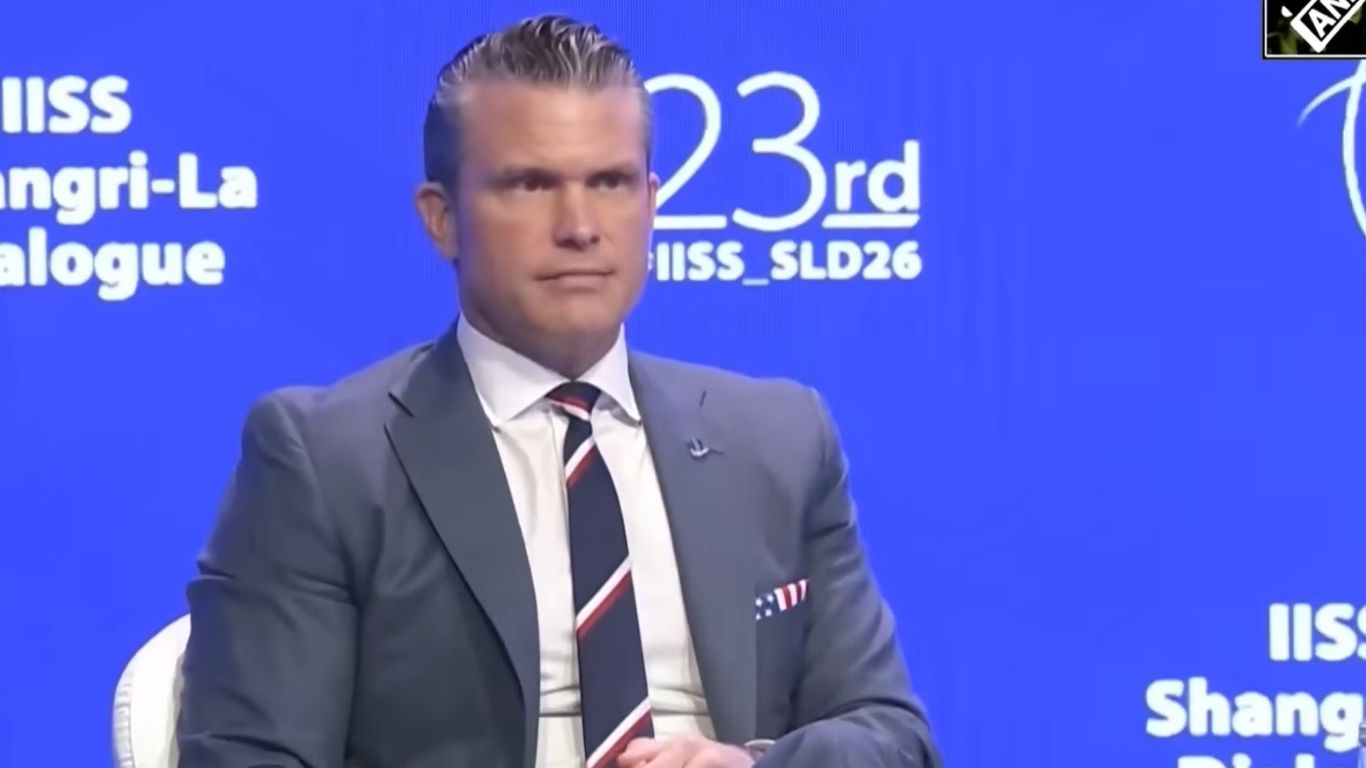
SINGAPORE (Diya TV) — U.S. Defense Secretary Pete Hegseth has described the growing relationship between the United States and Pakistan as a “true friendship,” highlighting Islamabad’s role in diplomatic efforts related to the Iran conflict and signaling stronger cooperation between Washington and Islamabad.
Speaking during a question-and-answer session after his address at the Shangri-La Dialogue security summit in Singapore, Hegseth said Pakistan’s leadership has played an important role in efforts aimed at reducing tensions in the region. His remarks come as the United States continues negotiations with Iran and seeks to stabilize a volatile Middle East.
Hegseth credited Pakistan Army chief Field Marshal Asim Munir and Prime Minister Shehbaz Sharif for supporting peace initiatives linked to the ongoing Iran crisis. He described the improving U.S.-Pakistan relationship as “an unexpected development and a true friendship.” Hegseth said both countries have found common ground on regional security issues and diplomatic efforts. The Pentagon chief also pointed to President Donald Trump’s involvement in helping ease tensions between India and Pakistan during their military confrontation last year. He said that effort reflected Washington’s commitment to promoting stability in South Asia.
The comments mark another sign of warming ties between the United States and Pakistan after years of strained relations over security and regional policy differences.
Hegseth also expressed confidence about ongoing negotiations between Washington and Tehran. He said discussions remain productive and that the United States is in a “good place” regarding talks with Iran.
However, he emphasized that Trump would only approve an agreement if it met U.S. security interests.
“Any deal that the president is willing to make, he’s only going to make it if he believes it’s a great deal for our country and the security of the world,” Hegseth said.
He added that Iran understands what steps it must take if it wants a deal with Washington. The defense secretary said Trump remains patient but will not rush into an agreement. His comments came as the White House signaled that negotiations are approaching a critical stage.
Trump outlined several conditions that he said would be necessary for a settlement with Iran. According to the president, the United States would lift its naval blockade of Iranian ports if Tehran permanently abandons efforts to acquire a nuclear weapon. He also said Iran would need to reopen the Strait of Hormuz to unrestricted shipping, remove naval mines from the strategic waterway, and cooperate with international inspectors. A White House official said Trump would only accept an agreement that satisfies U.S. security requirements and prevents Iran from obtaining nuclear weapons. Trump also stated on social media that Washington and Tehran could work together to locate and eliminate Iran’s enriched uranium stockpiles as part of a broader agreement.
Iranian officials strongly challenged Trump’s statements and negotiating terms. Mohsen Rezaei, an adviser to Iran’s supreme leader and a former commander of the Islamic Revolutionary Guard Corps, accused Trump of undermining diplomatic efforts. He said the continued naval blockade and what he described as excessive demands showed that Washington was pursuing objectives beyond negotiations. Iranian media outlets also disputed key elements of Trump’s account. Fars News Agency reported that Tehran wants the immediate release of $12 billion before moving forward with the next phase of talks.
The report also said a toll-free reopening of the Strait of Hormuz was not included in the current negotiation framework. Iranian sources further rejected Trump’s claim that both sides had agreed to destroy Iran’s nuclear material. Meanwhile, Iranian lawmaker Alireza Salimi said parliament is preparing to approve measures reinforcing Iran’s authority over the Strait of Hormuz.
Diplomatic efforts face additional challenges as military tensions remain high. Iranian media reported that air defense forces recently shot down a drone allegedly linked to U.S. and Israeli forces. The incident followed U.S. strikes on Iran’s Bandar Abbas port and subsequent Iranian retaliation. The conflict has also affected neighboring Lebanon. Iranian officials have repeatedly argued that any agreement must address hostilities involving Lebanon.
Israeli military operations continued in southern Lebanon, with evacuation warnings issued for several villages. Lebanese President Joseph Aoun urged diplomatic efforts during a phone call with U.S. Secretary of State Marco Rubio and called for an immediate ceasefire. As negotiations continue, the outcome of U.S.-Iran talks could shape regional security, global energy market,s and the future of American relations with key partners, including Pakistan.