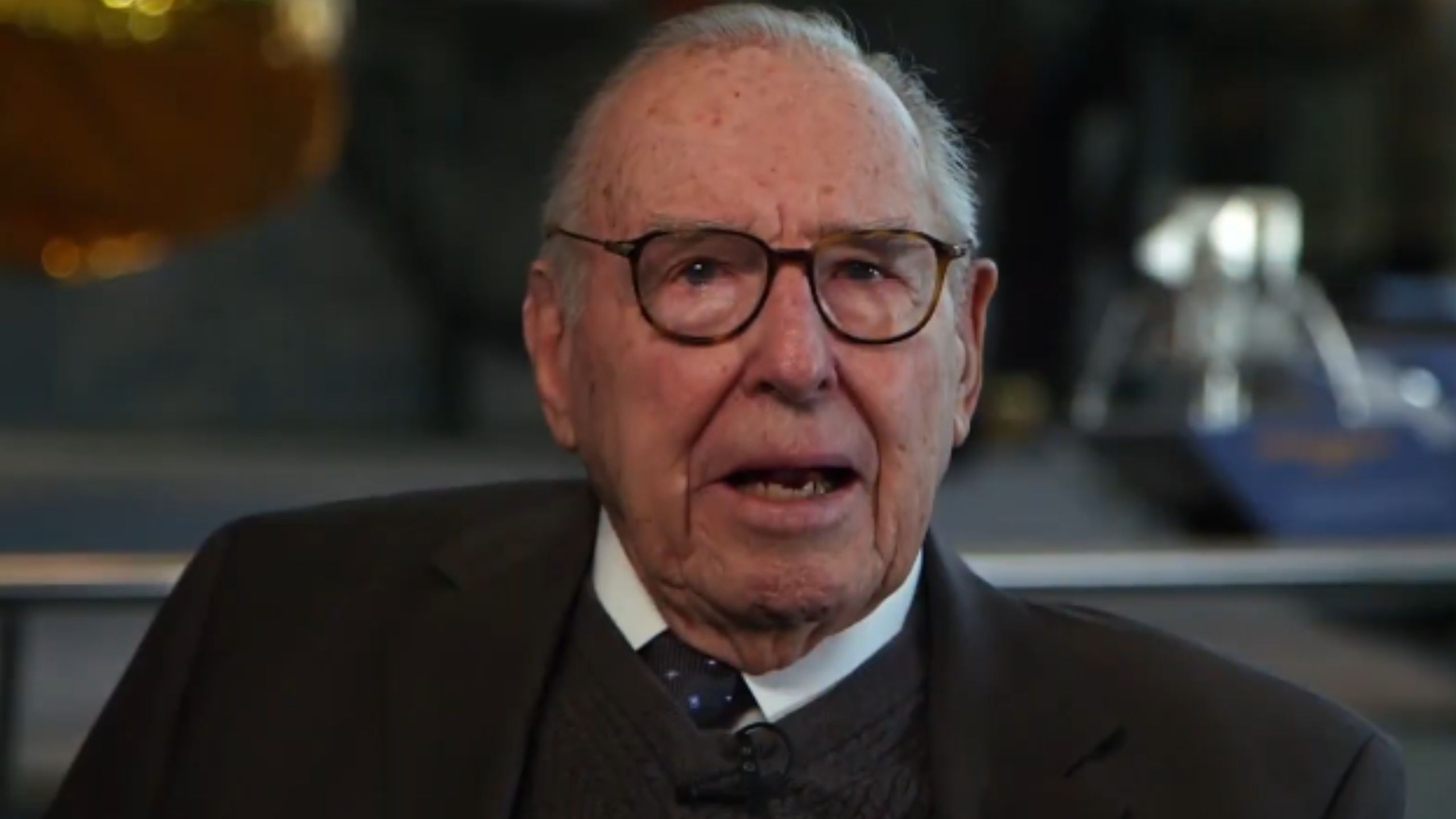
LAKE FOREST, Ill. (Diya TV) — James A. Lovell, the Apollo 13 commander who turned a near disaster into one of NASA’s greatest triumphs, has died. He was 97. NASA announced Friday that Lovell died Thursday in Lake Forest, Illinois. The agency praised his “character and steadfast courage,” saying his leadership helped save a crew in peril and taught the space program valuable lessons.
Lovell was one of NASA’s most experienced astronauts during its first decade. He flew four missions: Gemini 7, Gemini 12, Apollo 8 and Apollo 13. His two Apollo flights drew worldwide attention.
In 1968, Lovell joined Frank Borman and William Anders on Apollo 8. The crew became the first humans to leave Earth’s orbit, fly to the moon and circle it. They could not land, but the mission gave the United States a lead in the space race with the Soviet Union. Their photo of Earth from lunar orbit and a Christmas Eve reading from Genesis moved millions during a turbulent year in America.
Lovell’s most famous mission came in April 1970. Apollo 13 was on its way to the moon when an oxygen tank exploded 200,000 miles from Earth. Lovell was supposed to be the fifth man to walk on the moon, but the mission changed instantly.
The blast crippled the spacecraft. Oxygen began leaking. The crew — Lovell, Fred Haise and Jack Swigert — moved into the lunar module to use it as a lifeboat. For four freezing days, they rationed oxygen, water and electricity while swinging around the moon and racing back to Earth.
“We knew we were in deep, deep trouble,” Lovell later said.
NASA’s flight director Gene Kranz and hundreds of engineers worked nonstop on the rescue plan. With Lovell’s calm leadership, the astronauts returned safely. The tense survival story captured the world’s attention.
Lovell summed it up years later: “In some sense it was very much of a success. Not that we accomplished anything, but a success in that we demonstrated the capability of NASA personnel.”
The 1995 film “Apollo 13,” starring Tom Hanks as Lovell, retold the drama. The movie made famous the line “Houston, we have a problem,” a slight variation on Lovell’s actual words: “Houston, we’ve had a problem.”
Lovell, a retired Navy captain, was known for his steady demeanor. Smithsonian historian Roger Launius described him as a “down-to-earth type of person” who understood risk but stayed confident.
Until the Skylab missions in the mid-1970s, Lovell held the record for the most time in space — more than 715 hours. Apollo 8 also held special meaning for him. Orbiting the moon, he imagined being “a lonely traveler from another planet” and wondered if Earth might appear inhabited from afar.
James Arthur Lovell Jr. was born March 25, 1928, in Cleveland. He attended the University of Wisconsin before graduating from the U.S. Naval Academy in 1952, the same day he married his wife, Marilynn.
He became a Navy test pilot before NASA selected him as an astronaut in 1962. Lovell retired from both the Navy and the space program in 1973.
In 1994, he co-wrote “Lost Moon” with journalist Jeff Kluger, the book that inspired the “Apollo 13” film. Lovell even appeared in the movie as a Navy captain.
Later, he and his family opened a restaurant, Lovell’s of Lake Forest, which has since closed.
His wife, Marilynn, died in 2023. Lovell is survived by four children.
President Bill Clinton awarded Lovell the Congressional Space Medal of Honor in 1995. At the ceremony, Clinton told him, “While you may have lost the moon, you gained something far more important: the abiding respect and gratitude of the American people.”
Lovell admitted one regret — never walking on the moon. But he took pride in what Apollo 13 proved. “The mission itself and the fact that we triumphed over a certain catastrophe does give me a deep sense of satisfaction,” he said in 2004.
Lovell understood why the mission’s failure became his most famous achievement. “Going to the moon, if everything works right, it’s like following a cookbook,” he said. “If something goes wrong, that’s what separates the men from the boys.”