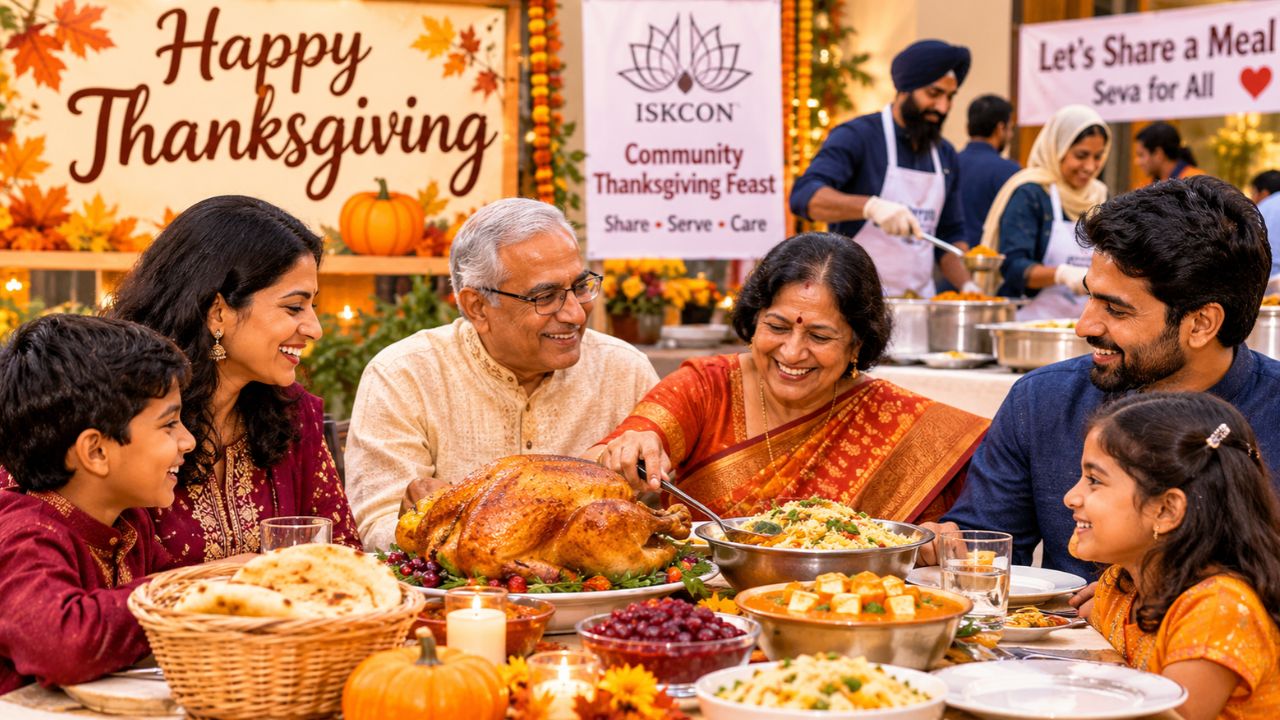
NEW YORK (Diya TV) — For many Indian American families, Thanksgiving dinner brings turkey and cranberry sauce to the same table as tandoori spices, biryani and matar paneer. The holiday has become a way to celebrate American traditions while keeping family recipes and cultural practices close.
Thanksgiving falls on Nov. 26 this year. Across the country, temples and community groups are also marking the holiday with shared meals and service projects.
ISKCON Houston has announced a Thanksgiving feast open to the public. In Brooklyn, ISKCON New York City plans an evening dinner at Govinda’s, with dishes including quinoa pulao, baked paneer kebab, vegetable quiche and cheesecake. Organizers say they will use proceeds to support a book-distribution campaign.
In New Jersey, volunteers with Let’s Share a Meal prepared food on Nov. 14 for the group’s annual Thanksgiving and Guru Nanak Dev Ji seva drive. The event drew on the Sikh practice of seva, or selfless service, and the tradition of langar, a community meal open to all.
At home, families have adapted Thanksgiving menus in different ways. Some cook a conventional turkey; others season it with Indian spices or serve vegetarian dishes alongside traditional sides.
In a 2016 account on journalist Lavina Melwani’s website, Shirley Khemlani recalled making her first turkey after moving to New York in 1979. She turned to neighbors for help when the unfamiliar bird’s size overwhelmed her. Sunita Advaney, who was 7 when her immigrant parents bought their first Thanksgiving turkey, later helped expand the family menu. They eventually prepared two birds: one traditional, the other seasoned with tandoori spices and stuffed with biryani and boiled eggs.
Other families built menus around dietary needs. Meena Patel prepared a vegetarian Thanksgiving meal for her Gujarati family and asked her nonvegetarian sister-in-law to bring turkey for children who wanted it.
Chefs have also put Indian dishes on Thanksgiving menus. In a 2019 interview with The Splendid Table, chef Maneet Chauhan described a restaurant menu she called “Thanksgiving meat and nine.” It included turkey tikka masala, a paneer option, vegetable pulao-biryani stuffing, cranberry five-spice chutney and sweet potato raita.
Chauhan also recalled her first Thanksgiving in the United States, when a faculty member invited students who could not travel home to celebrate with the family. The invitation shaped her view of the holiday as an act of hospitality.
Food writer Priya Krishna described another family version in a 2018 essay for Bon Appétit. Her family served matar paneer, squash, chickpeas and puri. Her mother noticed that cranberry sauce resembled chutney, and the sauce became a regular part of their meal.
These family menus vary, but they share a practical approach: people bring the dishes they love and make room for one another’s traditions. Community meals extend that welcome beyond the home, pairing holiday gatherings with food distribution and service.