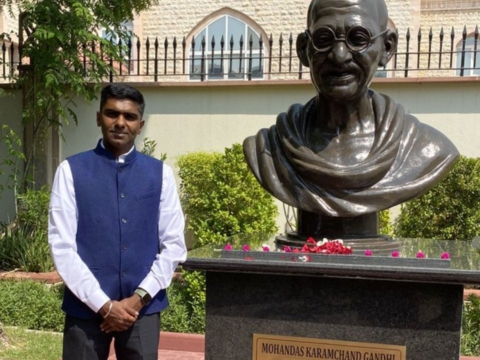
NEW DELHI (Diya TV) — India aims to attract up to $200 billion in data center investments over the next few years as it ramps up efforts to become a global hub for artificial intelligence. The country’s minister for electronics and information technology, Ashwini Vaishnaw, said the government is building strong AI infrastructure and offering policy support to draw global capital.
The push highlights India’s growing role in the global AI race. Major technology companies see India as both a vast market and a deep talent pool. For New Delhi, the investments promise faster digital transformation, job creation, and stronger economic growth.
India wants to position itself as a trusted AI partner, especially for developing nations seeking affordable and open solutions. Vaishnaw said the country offers scale, talent, and a stable policy environment.
“Today, India is being seen as a trusted AI partner to the Global South nations,” he said in an email interview.
The government believes AI must deliver measurable results for society. Leaders want AI to improve governance, health care, agriculture,e and education. They also want to avoid limiting advanced technology to a few rich countries or large corporations.
India’s strategy centers on building world-class data centers, expanding cloud computing, and strengthening semiconductor supply chains. The government recently announced a long-term tax holiday for data centers. Officials hope this move will provide certainty and attract foreign investment.
Global technology firms have already committed billions of dollars. Google announced a $15 billion investment plan in India over five years to establish its first artificial intelligence hub in the country. The move signals strong confidence in India’s digital economy and AI potential. Microsoft followed with a $17.5 billion investment to expand cloud and AI infrastructure over four years. The company described it as its largest investment in Asia.
Amazon has also committed $35 billion by 2030 to expand its business in India, with a focus on AI-driven digitization and cloud services. These announcements form part of the $200 billion investment pipeline that India expects to materialize in the coming years.
Infrastructure remains a central pillar of India’s AI strategy. Vaishnaw said the government has operationalized a shared computing facility with more than 38,000 graphics processing units, or GPUs. Startups, researchers, and public institutions can access high-end computing power without high upfront costs.
Officials believe this shared model will lower barriers to entry and encourage innovation. “AI must not become exclusive. It must remain widely accessible,” Vaishnaw said. India is also backing the development of sovereign foundational AI models trained on Indian languages and local data. Leaders say some of these models meet global benchmarks and perform well on specific tasks. The government wants to ensure that AI tools reflect India’s cultural and linguistic diversity.
India seeks a stronger voice in global AI governance. Vaishnaw said the country does not see itself only as a rule maker or rule taker. Instead, India wants to help create practical and workable global frameworks.
Officials aim to build trusted AI systems while addressing risks such as misinformation and misuse. The government has outlined a four-part strategy. It includes implementable global standards, reliable AI infrastructure, regulation of harmful content, and stronger human and technical capacity. India’s approach focuses on inclusive and development-driven growth. Leaders want AI to create jobs and boost productivity rather than widen inequality.
As AI adoption accelerates, India is investing in education and skills training. The government’s AI Mission program promotes sector-specific solutions through public-private partnerships. Universities and online platforms are expanding AI courses and certification programs. India also benefits from widespread 5G connectivity and a young, tech-savvy population. These factors could speed up AI adoption across industries.
At the same time, policymakers acknowledge concerns about job disruption. White-collar and technology roles face increasing automation risks. Officials say reskilling programs will help workers adapt to new roles in AI services, data management, and digital operations.
India’s AI strategy blends self-reliance with global integration. The country aims to develop applications, models, chips, and energy systems while staying connected to global markets. Investor confidence remains crucial as global tech funding slows. India hopes policy stability and large-scale infrastructure projects will reassure investors.
“The future of AI should be inclusive, distributed, and development-focused,” Vaishnaw said.