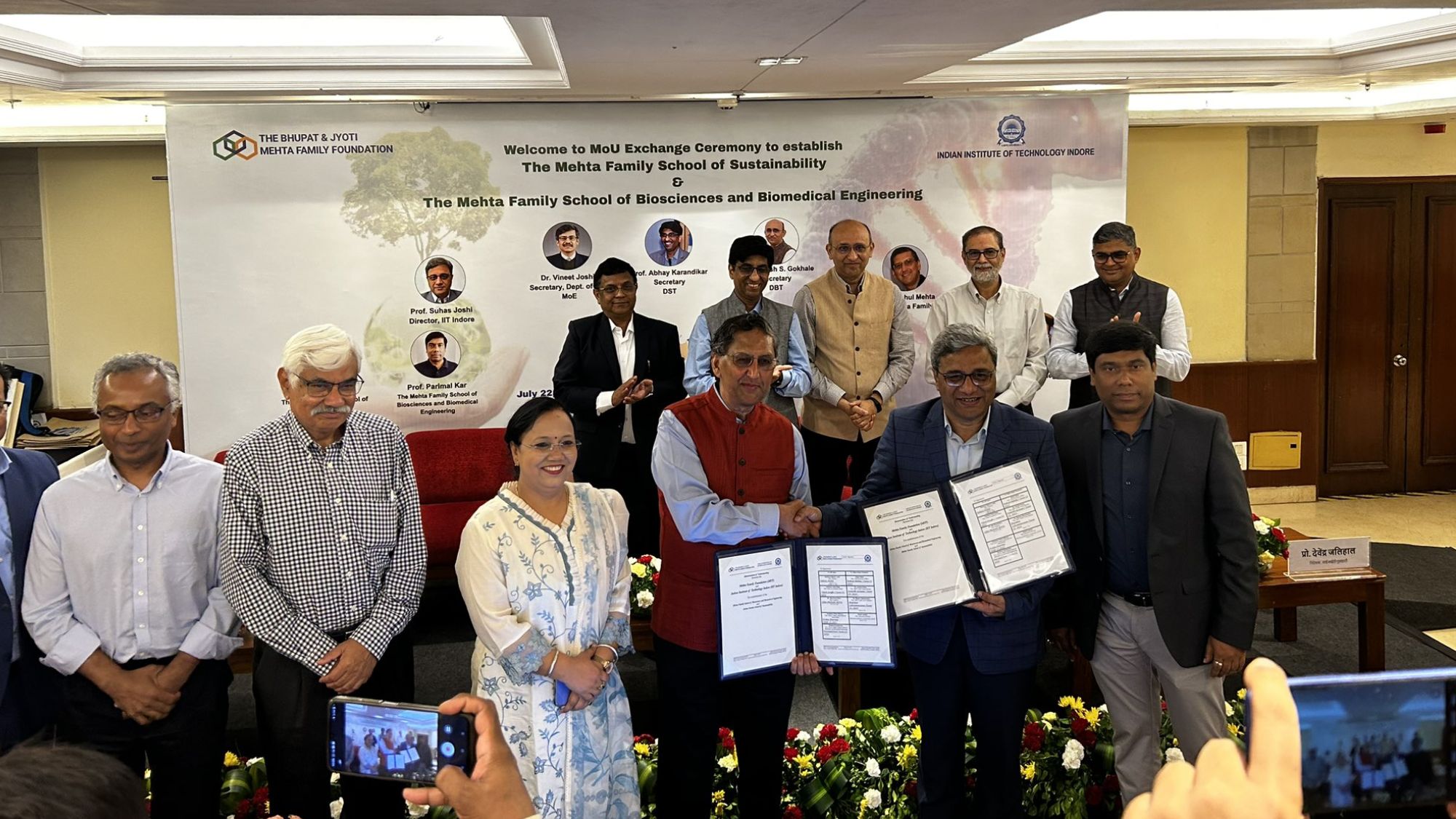
NEW DELHI (Diya TV) — The Indian Institute of Technology Indore (IIT Indore) has partnered with the Texas-based Bhupat & Jyoti Mehta Family Foundation (MFF) to launch two new academic schools focused on sustainability and biomedical engineering.
At a formal ceremony held in New Delhi, officials announced the creation of the Mehta Family School of Sustainability and the Mehta Family School of Biosciences and Biomedical Engineering. The schools span more than 200,000 square feet and are designed to serve over 1,500 students each.
This collaboration marks the largest single philanthropic contribution to IIT Indore to date. The initiative aims to support India’s growing need for advanced research and education in sustainability and health sciences.
The Mehta Family School of Sustainability introduces India’s first undergraduate program in environmental economics and sustainable engineering. The school will also house three Centers of Excellence: Energy Systems, Environmental Economics and Law, and Water and Climate Studies.
These centers will focus on research and training that supports climate resilience and sustainable development. Over the next 10 years, the school plans to train more than 1,400 professionals in these critical areas.
Rahul Mehta, founder of the Mehta Family Foundation, said the goal is to build institutions that help solve real-world challenges.
“India’s future hinges on nurturing institutions that can create intellectual talent to address challenges such as climate resilience and innovative healthcare,” Mehta said. “IIT Indore, located at the heart of India, has all the right ingredients to nurture the next generation of talent.”
The new Mehta Family School of Biosciences and Biomedical Engineering will act as a hub for data-driven healthcare innovation. Its academic offerings will focus on areas such as artificial intelligence in healthcare, drug discovery, biomanufacturing, and wearable technologies.
The school aims to support India’s biotechnology sector by helping address national challenges like endemic diseases, antimicrobial resistance, and gaps in biomanufacturing infrastructure.
The institute plans to launch a new biomanufacturing hub to boost local innovation and industrial capacity.
The Government of India has backed the initiative, calling it a step forward in aligning education with national science and technology goals.
Prof. Abhay Karandikar, Secretary of the Department of Science and Technology, praised the foundation’s vision.
“The Mehta Family Foundation’s ability to identify thematic areas that closely mirror the government’s science and technology priorities is commendable,” Karandikar said. “Such efforts strengthen India’s innovation ecosystem and contribute meaningfully to our long-term national goals in research and education.”
Dr. Rajesh S. Gokhale, Secretary of the Department of Biotechnology, also lauded the effort.
“It’s inspiring to see the convergence of engineering and biology being harnessed to address future grand challenges,” Gokhale said. “Their long-term vision aligns well with emerging national frameworks like the Bio-E3 policy. This support helps industrialize innovation and keeps India competitive globally.”
The Bhupat & Jyoti Mehta Family Foundation is based in Houston, Texas. It was founded by Nisha, Rahul, Jainesh and Mamta, and Dharmesh and Archana Mehta in honor of their parents, Bhupat and Jyoti Mehta of Mumbai.
The foundation has supported more than 100 educational and healthcare organizations globally for over two decades. Its mission is rooted in the belief that education transforms lives.
Dr. Suhas Joshi, Director of IIT Indore, emphasized the long-term impact of the partnership.
“MFF, along with its financial support, brings a deep network of academic expertise, industry leaders, and international collaborators,” Joshi said. “Together, we aim to set new benchmarks in interdisciplinary education and research that addresses critical societal issues.”
The partnership represents a major leap for IIT Indore and strengthens India’s position in sustainability and biotechnology education. As climate change and public health challenges rise, the two new schools are expected to play a key role in training leaders of the future.