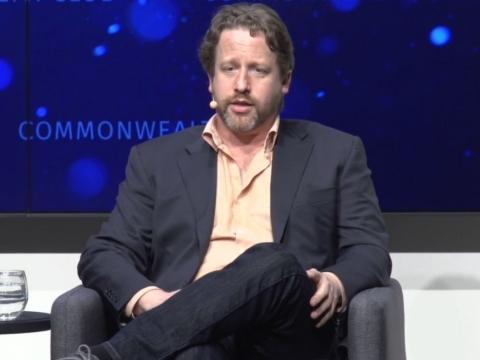
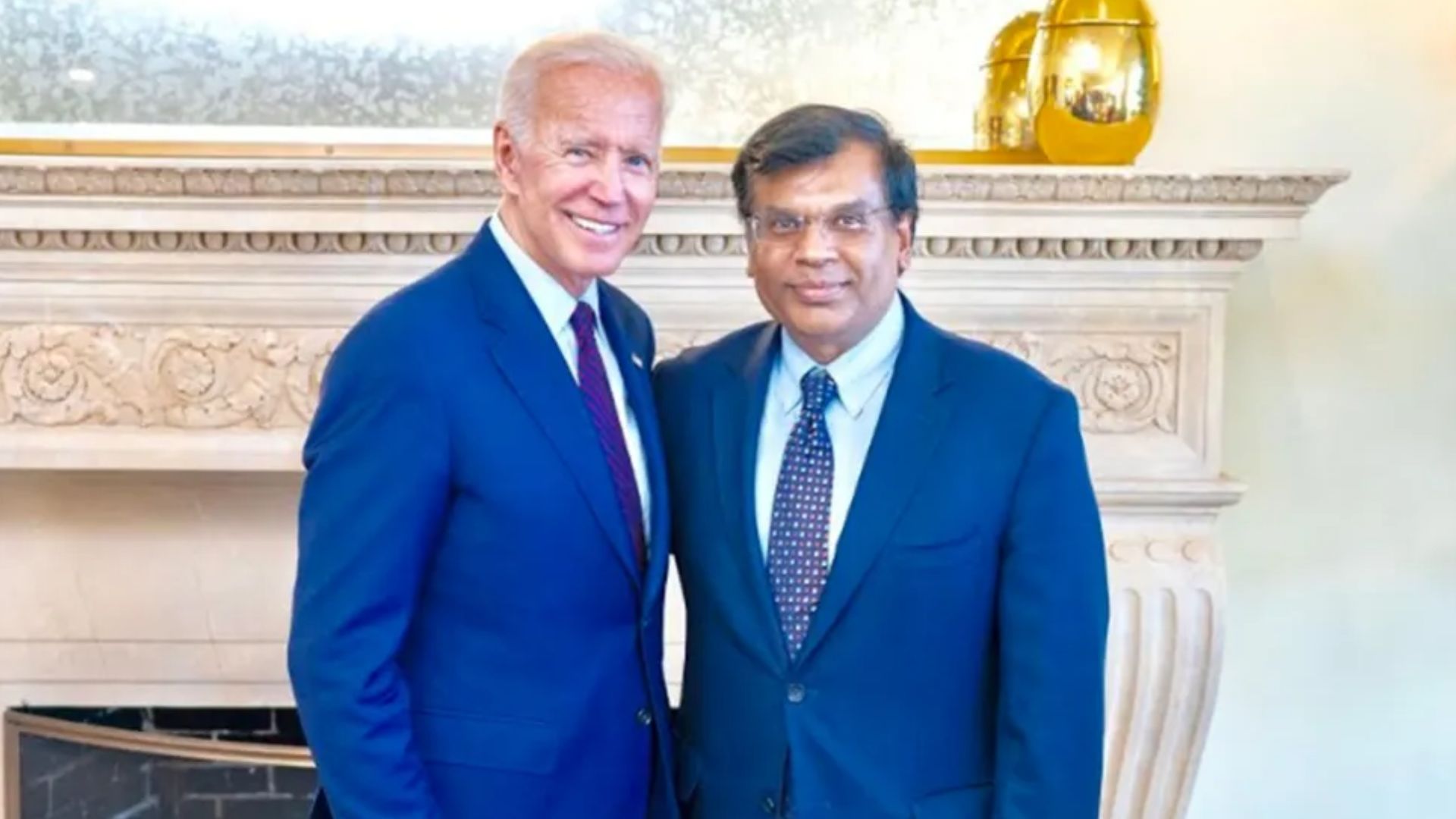
SAN DIEGO (Diya TV) — Dr. Vivek Lall, the Indian American aerospace leader and Chief Executive of General Atomics Global Corporation, has joined the Space Policy Institute (SPI) at George Washington University as a non-resident scholar, where he is expected to contribute his expertise on advanced space technologies and global security policy.
SPI announced Lall’s appointment in a statement, praising his distinguished career at the intersection of defense innovation, international collaboration, and aerospace development. The institute highlighted his pivotal role in strengthening U.S.-India defense relations and advancing unmanned aircraft systems, noting that his experience “positions him to contribute valuable insights into the evolving dynamics of space governance and military applications.”
“We look forward to his contributions in shaping forward-looking strategies that address critical challenges in space policy and security,” the institute added.
Lall leads General Atomics Global Corporation, headquartered in San Diego, California. The company, and its affiliated entities operating on five continents, is known for producing cutting-edge unmanned aircraft such as the Predator, Reaper, and Guardian. The defense contractor also develops advanced surveillance systems, electromagnetic aircraft launch and recovery systems, high-powered lasers, hypervelocity projectiles, satellite surveillance tools, and electromagnetic railguns.
Beyond aerospace and defense, General Atomics is a key private-sector player in thermonuclear fusion research, contributing to the internationally recognized DIII-D National Fusion Facility and the company’s inertial confinement fusion initiatives. The firm is also pushing the frontier on next-generation nuclear fission and high-temperature materials technology.
Lall’s career spans several decades across prominent aerospace and defense organizations. Before taking the helm at General Atomics Global Corporation, he served as Vice President of Aeronautics Strategy and Business Development at Lockheed Martin, the world’s largest defense contractor. Earlier, he held leadership roles at General Atomics Electromagnetic Systems and Boeing, where he contributed to the Airplane Performance and Propulsion Group in Seattle between 1996 and 2011. He also previously worked at Raytheon and collaborated on research projects with NASA’s Ames Research Center.
His influence stretches well beyond the private sector. Lall serves as a Distinguished Visiting Fellow at Stanford University’s Hoover Institution and sits on the Business Advisory Board of the Geneva-based World Association of Investment Promotion Agencies (WAIPA). He is a member of the Advisory Board of the Quad Investors Network, an initiative announced by the White House, and was appointed by the Pentagon as a U.S. technical team member to NATO’s Science and Technology Organization (STO). Lall also advises the American Society of Mechanical Engineers (ASME) and holds seats on the boards of the U.S.-Japan Business Council and the U.S.-India Business Council, both based in Washington, D.C.
His contributions have earned him numerous honors, including the President’s Lifetime Achievement Award, which he received from the White House in September 2022. The Cambridge Biographical Centre in the U.K. also listed him among the “2000 Outstanding Scientists of the Twentieth Century.” Forbes featured him on its cover in January 2025, underscoring his influence in the world of advanced technologies and international defense.
An academic at heart, Lall holds a Ph.D. in Aerospace Engineering from Wichita State University, an MBA from City University in Seattle, a Master’s in Aeronautical Engineering from Embry-Riddle Aeronautical University, and a Bachelor’s degree in Mechanical Engineering from Carleton University in Canada. He also worked as an adjunct faculty member at Embry-Riddle and trained as a private pilot at Phoenix International Flight Training in Florida.
Throughout his career, Lall has authored more than 100 technical articles and served as founding co-chair of the U.S.-India Aviation Cooperation Program, launched in 2005. He also once served as a special advisor to the United Nations in New York, guiding policy on broadband and cybersecurity for global development.