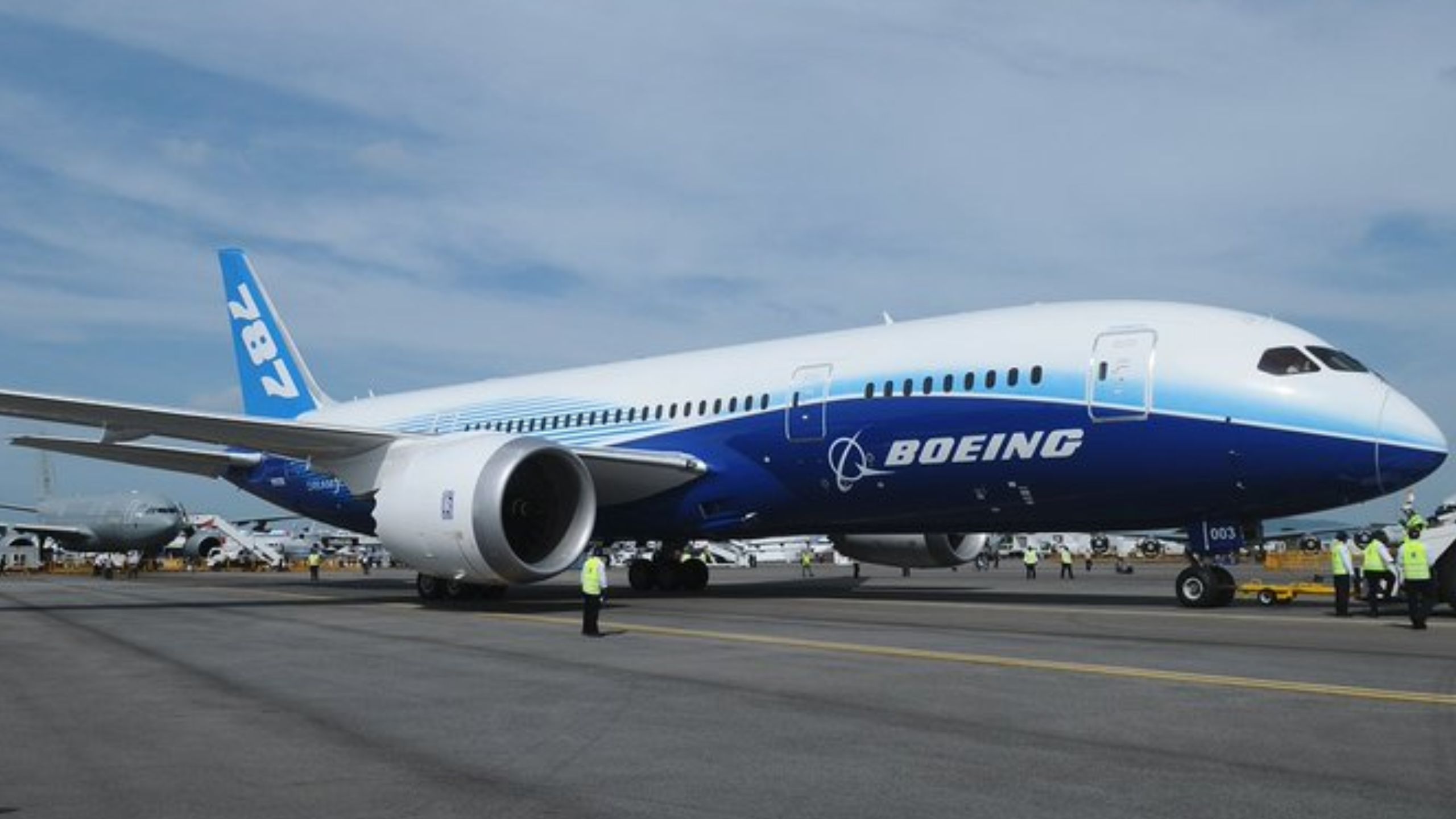
WASHINGTON (Diya TV) — The Federal Aviation Administration (FAA) has raised a new safety alert about certain Boeing 787 aircraft. The issue affects the 787-9 and 787-10 models. These planes could have critical components made from substandard titanium, which may put passenger safety at risk.
The FAA has proposed a new airworthiness directive (AD) to address the problem. The directive would require airlines to inspect and possibly replace faulty parts. This comes after several reports indicated that the forward fittings of the Ram Air Turbine (RAT) may have been made from an incorrect titanium alloy.
According to the FAA, the concern centers around the use of Grade 1 or Grade 2 titanium. These grades are commercially pure but lack the strength of Grade 5 titanium, which Boeing originally specified. The correct alloy—Ti-6Al-4V Grade 5—offers better strength, fatigue resistance, and damage tolerance.
The weaker titanium may fail during flight, especially when the RAT is deployed. A failed RAT fitting could result in the loss of emergency hydraulic or electrical power. It could even cause the RAT unit to break off the aircraft entirely.
The Ram Air Turbine (RAT) is a small, fold-out device. It uses wind from the plane’s motion to generate power in emergencies. If a jet loses both engines or electrical systems, the RAT keeps key systems running. These include flight controls, navigation, and communications.
Depending on the situation, the RAT can be deployed automatically or manually by the pilots. In high-stress scenarios, it becomes a critical backup to avoid catastrophe.
Reports suggest the suspect titanium came from China. Spirit AeroSystems, a major Boeing supplier, reportedly provided the parts. The affected planes were assembled at Boeing’s facility in North Charleston, South Carolina.
While Boeing has not confirmed the exact number of affected aircraft, it says it has already issued guidance. The company told customers of the 787-9 and 787-10 aircraft about the issue in February 2025.
Boeing said in a statement, “We issued guidance to our B787-9 and B787-10 customers in February 2025 and fully support the FAA’s proposal to make that guidance mandatory.” Boeing added that the current fleet can continue safe operations.
To identify the faulty parts, the FAA recommends two inspection methods. Airlines can use High-Frequency Eddy Current (HFEC) testing or a handheld X-ray Fluorescence (XRF) spectrometer. If tests reveal substandard parts, they must be replaced immediately with the correct alloy.
The FAA stressed that the condition, if not corrected, could lead to serious consequences. “A RAT forward fitting that was possibly manufactured with the incorrect titanium alloy material could fail when the RAT is deployed,” the agency said. “This condition… could result in loss of backup hydraulic and/or electrical power as well as the RAT module departing from the airplane.”
Air India, which recently merged with Vistara, now operates several 787 9 jets. These aircraft originally belonged to Vistara. Before the merger, Air India mainly flew the 787-8 variant. That model does not fall under the FAA’s current directive.
However, a tragic crash in Ahmedabad has drawn attention to the issue. On June 12, a Boeing 787-8 Dreamliner crashed shortly after takeoff. The RAT was deployed moments before the crash, which killed all but one passenger.
The FAA’s proposed directive does not cover the 787-8 model. However, the crash has raised new questions about aircraft safety and the reliability of emergency systems like the RAT.
The FAA’s proposal aims to prevent future incidents by ensuring that only approved materials are used in critical aircraft parts. Airlines flying the 787-9 and 787-10 models must act quickly to inspect their fleets.
While Boeing says the current fleet remains safe, the FAA’s concern shows that even small changes in material quality can lead to big risks in aviation. With global reliance on the Boeing 787 Dreamliner series, ensuring these aircraft are airworthy remains a top priority.