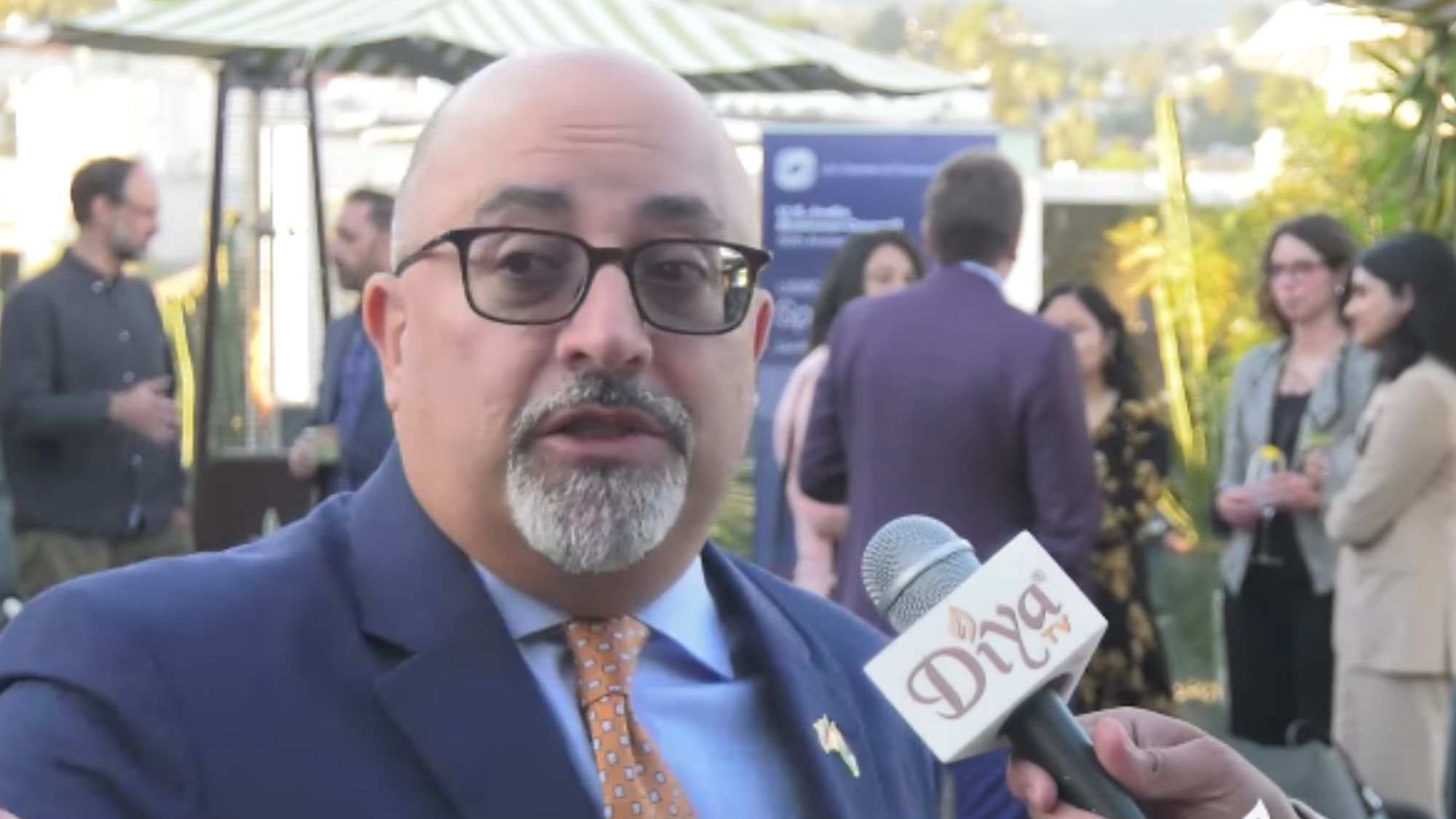
LOS ANGELES (Diya TV) — Tensions between the United States and India over trade are heating up once again, with former U.S. Ambassador and current USIBC President Atul Keshap urging both governments to finalize a long-awaited trade agreement. Speaking to Diya TV’s Ravi Kapur at the U.S.-India Business Council’s 50th anniversary event in Los Angeles, Keshap expressed hope that leaders from both nations will rise above public posturing to make real progress.
While trade negotiations have been ongoing for months, President Donald Trump said he would impose a 25% tariff on Indian goods starting August 1. The move has stirred concern among business leaders and investors. Keshap said this kind of aggressive rhetoric is not surprising.
“President Trump is a New York real estate negotiator. Everything is fair game,” Keshap said. “But I believe this is mostly posturing. What matters is that we get a real trade deal done.”
India’s rapid economic growth has led many American companies to increase their presence in the country. From tech giants to defense contractors, U.S. firms are investing heavily in India’s expanding markets. However, the absence of a formal trade agreement remains a key roadblock.
Keshap emphasized the importance of a deal to reduce trade barriers and encourage investment on both sides.
“A trade agreement sends a very powerful psychological message — a positive message — to investors, workers, and companies,” he said.
Without such an agreement, India could risk being left out of major global trade partnerships. The U.S. has already forged deals with the European Union, Japan, Vietnam, and others. Despite deepening economic and strategic ties, disagreements remain. Trade tensions, tariffs, and political differences continue to create friction. Yet Keshap believes both countries share a larger goal.
“We are the world’s two largest democracies. We are Quad partners. We have shared adversaries. We need to get this done,” he said.
Behind the scenes, U.S. and Indian negotiators have reached a “reasonable set of mutual accommodations.”
Now, he said, it’s time for leadership to step in.
“Every government negotiation ultimately goes to the top. The boss is the boss,” Keshap said, recalling how former President George W. Bush and Indian Prime Minister Manmohan Singh finalized the landmark U.S.-India nuclear deal.
Keshap warned that if no agreement is reached soon, American foreign direct investment in India could slow. Projects involving advanced technologies like artificial intelligence, semiconductors, and defense may also face delays. He added that business leaders are ready for stronger ties but need clarity from both governments.
“Beyond Washington and Delhi, there is tremendous activity — people, academia, scientific establishments. But without a trade agreement, things become more complicated,” he said.
Keshap described the ongoing trade talks as “brass knuckles negotiating.” While the tone may seem harsh, he believes it reflects a commitment to honesty and progress.
“There’s been a lot of truth-telling behind closed doors,” he said. “And honesty is the way forward in a negotiation.”
He also pushed back against concerns that new U.S. officials might not understand India’s historical alliances with countries like Russia and Iran. He believes the current administration is well aware of India’s strategic complexities. The pressure is now on President Trump and Indian Prime Minister Narendra Modi to finalize a deal. The stakes are high, not only for the two nations but also for global markets and regional security.
“If the U.S. and India don’t get this deal done while other countries are moving forward, it will hurt us both,” Keshap said. “The world is watching to see if our two great democracies can rise to the moment.”
For businesses and policymakers alike, the message is clear: time is running out, and the window to secure a transformative U.S.-India trade deal is now.