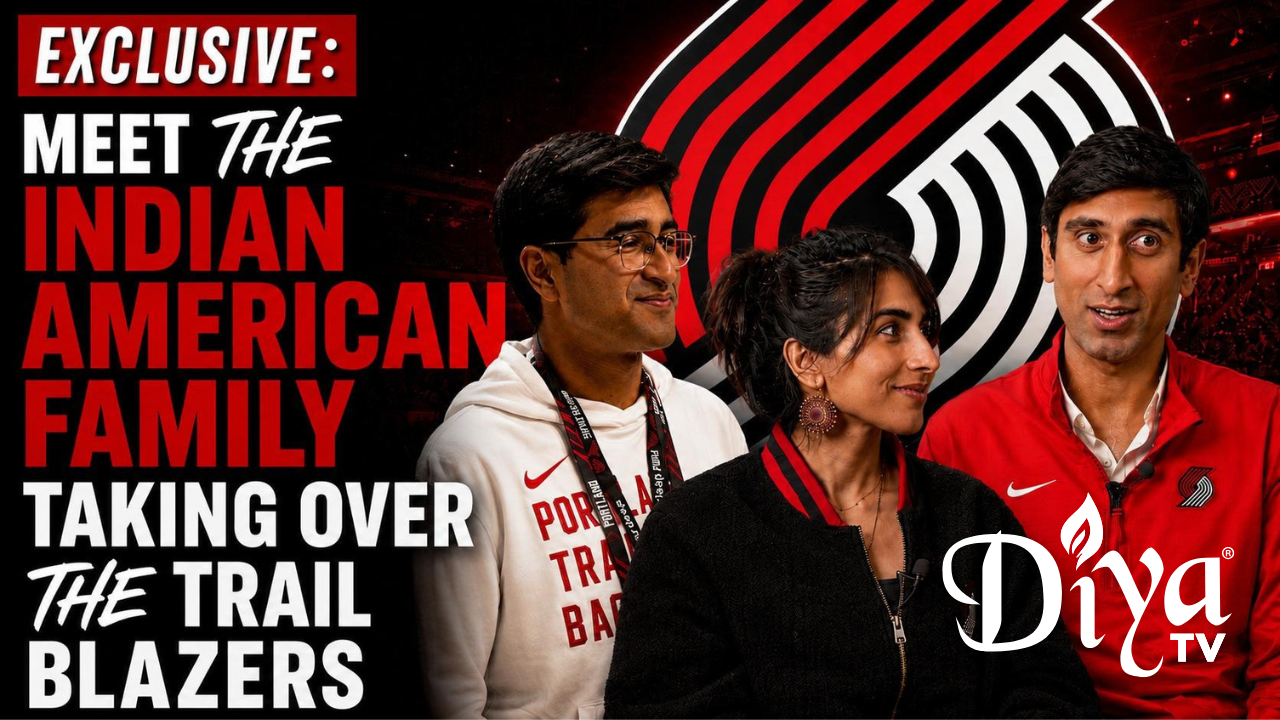
PORTLAND, Ore. (Diya TV) — The Portland Trail Blazers are entering a new era of ownership, and an Indian American family is playing a central role in shaping what comes next for one of the NBA’s most recognizable small-market franchises.
On a special Diya TV Spotlight from the Moda Center in Portland, Diya TV’s Ravi Kapur spoke with Sheel Tyle, Dr. Sejal Hathi Tyle, and Sujay Tyle about their entry into NBA ownership, their commitment to Portland, and their long-term vision for the Trail Blazers.
The new ownership group is led by Carolina Hurricanes owner Tom Dundon, with the Tyle family serving as part of the local leadership behind the franchise. Sheel Tyle will serve as an alternate governor for the team, while Dr. Sejal Hathi Tyle has joined the board of the Trail Blazers Foundation.
Over the years, Indian American and South Asian figures such as Vivek Ranadivé, Shahid Khan, Aditya Mittal, and Vinod Khosla have become part of major sports ownership circles. The Tyles now represent a younger generation stepping into that space, with a combination of venture capital, entrepreneurship, public service, and local civic engagement.
For Sheel and Sejal, the path to the Blazers began after they moved to Oregon two years ago for Sejal’s role leading the Oregon Health Authority. Sheel said their first serious sports ownership effort was not with the NBA, but with an attempt to revive a WNBA bid for Portland.
When that opportunity went to another group, the effort still introduced the Tyles to the sports ownership world. Later, when Jody Allen hired Allen & Company to oversee the sale of the Trail Blazers, Sheel said people began reaching out to see whether he and Sejal wanted to be involved. That eventually connected them with Dundon, who was looking for a local partner who could be present in Portland and deeply involved with the franchise.
Sheel described the decision as a major step for their family, but one they believed was worth taking.
Sejal said the move is about more than owning part of a team. To her, the Trail Blazers are deeply tied to Portland’s identity.
“The Trail Blazers are incredibly important to the fabric and the spirit of the state and of the city,” Sejal said. “We recognize that. We want to honor that. We want to celebrate that.”
She added that the franchise can play a role in Portland’s broader resurgence, calling the Blazers “indispensable” to that mission. Her comments framed the ownership group’s role not simply as investors, but as stewards of a civic institution.
That idea of stewardship came up repeatedly throughout the conversations. Sheel said growing up around small-market sports helped shape how he sees the Blazers. He pointed to his family’s connection to Buffalo and the Buffalo Bills as an example of how a team can become central to a city’s identity.
For Portland, he said, the Blazers carry a similar weight.
“The Blazers are all that Portland has in terms of big four sports,” Sheel said. “We wanted to be a part of something that had the ability to bring people together.”
That message also shaped the pitch made to the Allen family. According to Sheel, the winning bid was not only about price. It was also about presenting a diverse ownership group with the experience needed to strengthen the franchise. He highlighted Dundon’s sports ownership background, Mark Zahr’s real estate expertise, and the Cherng family’s local ties and immigrant story — the founders of Panda Express — as part of what made the group compelling.
The ownership group’s first major priority is competitive success. Sheel said the Blazers already have a strong foundation on the court and praised the roster’s resilience after a turbulent season. He pointed to the team’s defensive talent, international depth, and ability to compete despite injuries and instability.
But the new ownership group is also looking beyond the court. One major focus is the Moda Center, which Sheel described as the oldest NBA arena that has not undergone a major renovation. He said the goal is to improve the experience for fans and players, using newer arenas such as Chase Center and Intuit Dome as examples of what a modern NBA venue can offer.
“We think there’s a lot of things that can be done to better the fan experience and also better the experience for players,” Sheel said.
He added that Portland and the broader Pacific Northwest deserve a venue that feels comparable to the best arenas in major markets.
The Tyles also addressed early criticism and fan concern around possible organizational changes, including from how two-way players will be used to whether the team will continue to have two mascots. Sheel acknowledged that some decisions may be questioned and said the group is still early in its tenure.
“We’re three weeks in as new owners,” Sheel said. “But I promise you, and I want to promise the fans, we are 100% committed to winning.”
He said that winning must apply both on and off the court, and that the ownership group will adjust as it learns. On the mascot question, Sheel did not commit to a specific outcome, saying the team is still evaluating its options. But he emphasized that the central focus should remain the players and the product on the court.
“What we want is everybody to focus on what matters, which is the product on the court and the players and cheering them on,” he said.
Sheel and his brother Sujay Tyle come from entrepreneurial backgrounds, with Sujay having built companies after becoming a Thiel Fellow and Sheel building a career in venture capital.
For them, the Blazers were not just another investment opportunity.
“This is more than an investment,” Sheel said. “This is something that everybody in the community and city and state can be really proud of.”
Sujay said basketball stood out because of its global reach and the rare chance to buy into a team with deep local roots. He noted that sports franchises do not become available often, sometimes remaining with the same owners for decades.
“The fact that my brother lives here in Portland and we could add a local angle — to keep it here, to really push for that, to actually be very hands-on — a lot of pieces came together at the right time,” Sujay said.
The brothers also laid out a broader business vision for the Blazers: make the team more global, more technologically advanced, and more connected to international audiences.
Sujay said one of the next questions is how to expand the team’s presence beyond Portland.
“How do we make this a global team?” Sujay said. “How do we put great technology in, bring it to Asia, bring it to Latin America?”
He argued that those efforts may not look like traditional financial initiatives at first, but they can grow the long-term value of the franchise by expanding the team’s audience and identity.
Technology is also expected to be part of the franchise’s future. Sheel said live sports may become even more important in an AI-driven era because people will continue to seek real-world shared experiences. He also pointed to analytics and player evaluation as areas where technology can change how teams operate.
“AI can see a million times what a scout can see,” Sheel said. “We’re just in the very early innings of seeing how technology can improve outcomes on the floor.”
The global strategy also connects to the current roster. Sheel noted that the Blazers have one of the NBA’s most international teams, with players from countries including China, Israel, Belgium, Australia, and France. He said that international makeup reflects where basketball is heading.
“People often say football, soccer is the most global sport,” Sheel said. “But actually basketball is giving it a pretty good run for its money.”
He said he and Sejal plan to look at ways to strengthen the franchise’s ties in Asia, including Japan, China, and Korea.
For the Tyle family, the moment also carries broader meaning for the Indian American community. Sejal said she hopes their involvement shows others that sports ownership is a path they can pursue.
“We may be the exception now,” Sejal said, “but I just hope that we’re the first of many to come.”
Sheel said he wants the next generation of Indian Americans to see that their ambitions do not have to fit into narrow career expectations.
“You don’t just have to be an engineer or a lawyer or only a physician,” he said. “You can do many things.”
As the Blazers begin this new chapter, the Tyles are positioning themselves as local, hands-on owners focused on winning, modernizing the fan experience, strengthening Portland’s civic pride, and growing the franchise’s global reach.
Sejal said the opportunity may be viewed as a step forward for their family, but they see it differently.
“We see it as a responsibility,” she said. “There’s a lot of work to do, and we’re here and ready and eager to partner with the broader community.”
For Portland, that work now begins with a new ownership group, an ambitious vision, and an Indian American family helping guide the Trail Blazers into their next era.