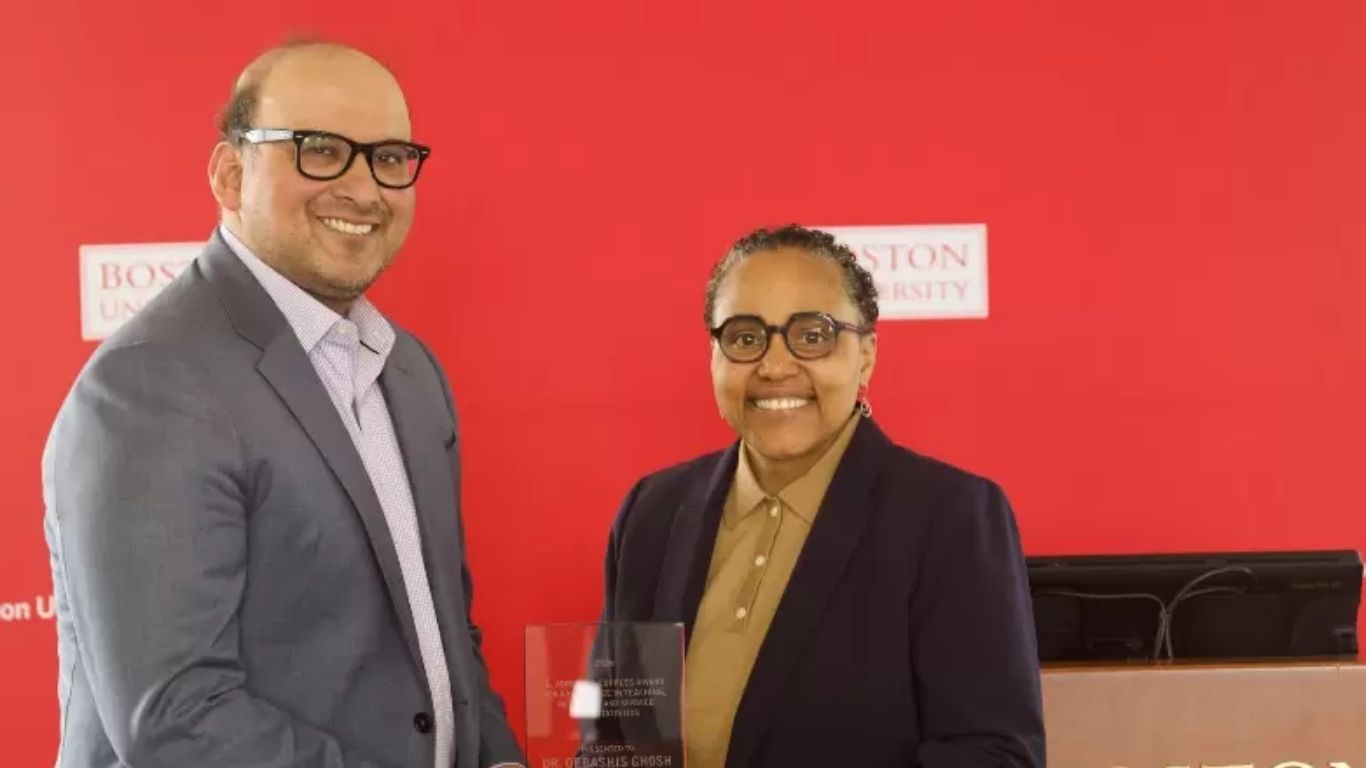
DENVER (Diya TV) — Indian American biostatistician and researcher Debashis Ghosh has received the 2026 L. Adrienne Cupples Award for Excellence in Teaching, Research, and Service in Biostatistics, recognizing his decades of work in statistical science, cancer research, and student mentorship.
The annual award comes from the Boston University School of Public Health Department of Biostatistics. It honors a biostatistician whose career reflects the academic legacy of the late Professor L. Adrienne Cupples. Ghosh, who serves in the Department of Biostatistics and Informatics at the University of Colorado Anschutz Medical Campus, accepted the award on April 3. He also delivered a lecture titled “Being a Statistician in the Age of AI,” where he discussed the growing role of artificial intelligence in science and society.
The award committee praised Ghosh for his leadership in teaching, mentoring, and scientific research. Members highlighted his guidance of doctoral and post-doctoral students and his work in cancer genomics, pediatric autoimmune disease, and healthy aging.
Ghosh has spent more than a decade at the University of Colorado Anschutz Medical Campus. Until 2024, he served as chair of the Department of Biostatistics and Informatics. Earlier in his career, he taught at Penn State University and the University of Michigan. His research focuses on statistical machine learning, biomarker evaluation, and causal modeling. Much of his work supports cancer-related studies and public health research. In Colorado, he has also collaborated on projects involving COVID-19 modeling, aging populations, minority health, and real-world medical evidence.
During his award presentation, Ghosh addressed the rapid growth of artificial intelligence in research and everyday life. He said he continues to explore how AI can support scientific work, but he also warned about possible risks tied to automation and large-scale systems.
“I’m using it, but I’m still in the exploration stage of seeing how it can help,” Ghosh said. “As a tool for automating systems and their use in broader society, this is probably what I’m most concerned about. I see a lot of ways in which things could go wrong.”
His remarks reflected broader conversations happening across universities and research institutions about the role of AI in medicine, public health, and academic research.
Ghosh also spoke about the influence of Cupples, a respected leader in biostatistics and genetic epidemiology. He praised her ability to connect different scientific disciplines during a period when many research groups worked separately.
“When I started in the 90s, I felt like there were often biostatistics groups and statistical genetics groups that were separate,” Ghosh said. “What was impressive about Cupples is that she really built this bridge between statistical genetics and genetic epidemiology.” He added that he admired the personal qualities highlighted in tributes written after Cupples’ death.
“I’d really like to be remembered in the same way,” Ghosh said, referring to descriptions of Cupples as “kind, empathetic, passionate.”
Ghosh has received several honors during his career in biostatistics and public health research. He is an elected Fellow of the American Statistical Association and the Institute of Mathematical Statistics. His awards include recognition from the International Indian Statistical Association, the American Public Health Association, and the Harvard T.H. Chan School of Public Health. He also received the 2025 WNAR Outstanding Impact Award and Lectureship.
Ghosh earned his doctorate in biostatistics from the University of Washington and completed his undergraduate studies in mathematics at Rice University.