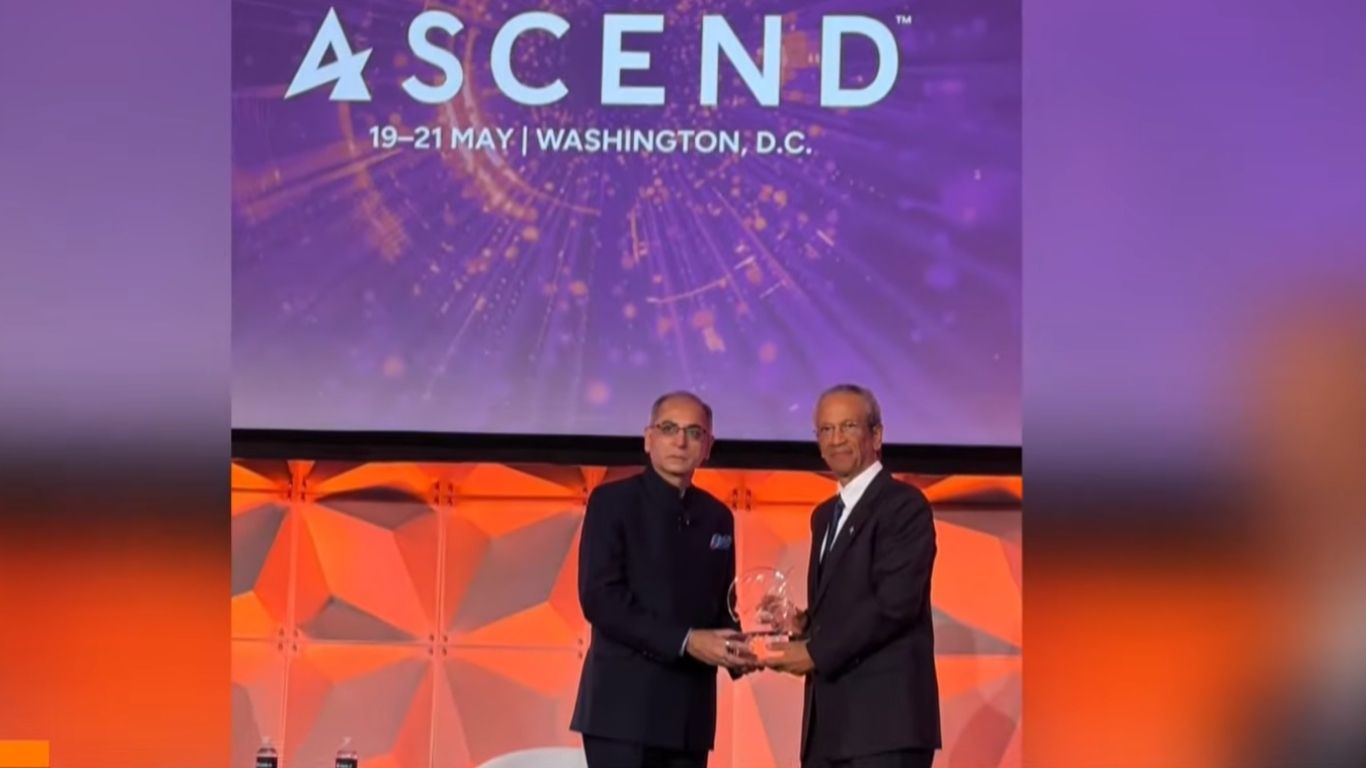
WASHINGTON (Diya TV) — India’s historic Chandrayaan-3 mission has received the prestigious 2026 Goddard Astronautics Award from the American Institute of Aeronautics and Astronautics, marking another major milestone for the country’s growing space program.
The award recognized Chandrayaan-3’s groundbreaking achievement as the first spacecraft to successfully land near the Moon’s south pole. The ceremony took place on May 21 during the AIAA ASCEND 2026 Conference in Washington. India’s Ambassador to the United States, Vinay Kwatra, accepted the award on behalf of the Indian Space Research Organisation.
India launched Chandrayaan-3 in 2023 as part of its ambitious lunar exploration program. On Aug. 23, 2023, the spacecraft completed a soft landing near the Moon’s south polar region. The landing marked a historic moment in global space exploration. No country had previously achieved a soft landing in the region. The mission placed India among the world’s leading space powers and strengthened the global reputation of ISRO.
Scientists consider the Moon’s south pole one of the most important areas for future exploration. The region contains permanently shadowed craters that may hold water ice and other valuable resources. Researchers believe those resources could support future human missions and long-term lunar habitation. Chandrayaan-3 delivered important scientific data from the lunar surface. According to the award citation, the mission confirmed the presence of key chemical elements in the lunar south polar soil. The findings increased hopes that future missions could use local resources for manufacturing and sustainable operations on the Moon.
The Goddard Astronautics Award ranks among the highest honors in the field of astronautics. The American Institute of Aeronautics and Astronautics presents the award to individuals or teams that make exceptional contributions to space science and exploration. The award honors pioneering rocket scientist Robert H. Goddard, whose experiments with liquid-fuel rockets helped lay the foundation for modern space travel.
AIAA expanded the award’s scope in 1975 to recognize broader achievements in astronautics beyond propulsion science. Since then, the organization has presented the award to major contributors in global space exploration and aerospace innovation. The recognition for Chandrayaan-3 highlights India’s growing role in international space research and advanced technology.
During the ceremony, Ambassador Kwatra highlighted Prime Minister Narendra Modi’s Space Vision 2047 initiative. The long-term strategy outlines India’s plans for deep-space exploration, human spaceflight missions, and expansion of the country’s commercial space sector. India has steadily increased investments in space technology, satellite launches, and scientific research in recent years.
Kwatra also stressed the importance of stronger cooperation between India and the United States in space exploration and technological innovation. He said collaboration between governments, industries, and research institutions would play a major role in shaping the future of global space missions. The event reflected the growing strategic partnership between the two countries in science, aerospace, and emerging technologies.
The success of Chandrayaan-3 came at a time when several countries are racing to expand their lunar programs. Nations including the United States, China, and Russia continue to develop missions focused on Moon exploration and future lunar habitation. India’s achievements have helped position ISRO as a key player in the new era of space exploration. The organization has moved beyond satellite launches into planetary missions, commercial space ventures, and preparations for human spaceflight.
The Chandrayaan-3 mission also boosted national pride across India and inspired growing interest in science and technology among young people.