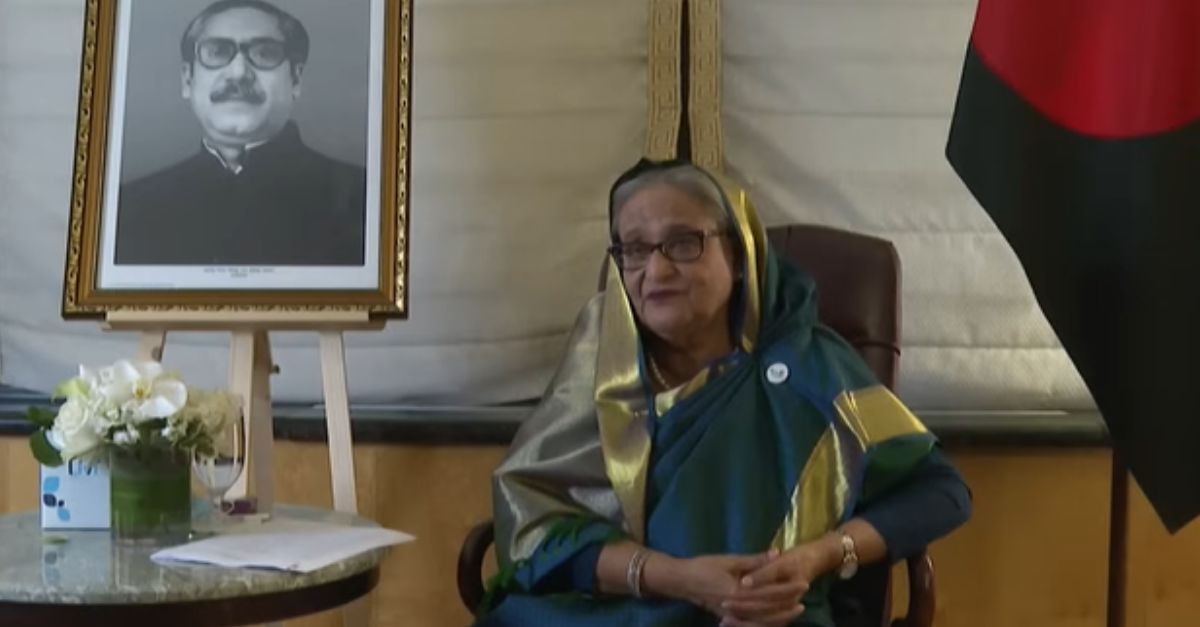
NEW DELHI (Diya TV) — Bangladesh’s ousted Prime Minister Sheikh Hasina has been sentenced to death after a domestic war crimes court found her guilty of crimes against humanity linked to a deadly crackdown on student protesters last year.
The International Crimes Tribunal in Dhaka delivered the verdict on Monday. A panel of three judges ruled that Hasina ordered and encouraged lethal force against student demonstrators who demanded reforms to civil service job quotas. The judges said she incited members of her ruling Awami League and law enforcement to “kill and eliminate the protesting students.” The courtroom erupted in applause as the sentence was announced.
Hasina lived in self-imposed exile in New Delhi during the trial. She called the judgment “biased and politically motivated” and rejected all charges. The former leader governed Bangladesh from 2009 until her ouster in 2024.
The protests began as peaceful student rallies but grew into a nationwide movement demanding Hasina’s resignation. Human rights monitors say the government crackdown may have killed up to 1,400 people. The UN human rights office reported that as many as 25,000 others were injured.
The tribunal said Hasina ordered the use of lethal weapons, drones, and helicopters to suppress crowds. She also faced accusations of ordering public hangings of demonstrators. She denied all allegations and said the trial lacked fairness and transparency.
The United Nations called the verdict an important moment for victims. However, it stressed its opposition to capital punishment. A spokesperson for the UN human rights office said trials for international crimes must meet the highest standards of due process. The spokesperson noted that Hasina’s trial took place in absentia, which raised concerns about fairness.
Hasina’s lawyers also appealed to the United Nations Special Rapporteur on extrajudicial executions, citing due process violations.
The ruling sparked celebrations among some protesters and sparked unrest in other parts of Dhaka. Students at Dhaka University held a rally and handed out sweets. Elsewhere, demonstrators tried to damage the historic home of Hasina’s father, Sheikh Mujibur Rahman, a national figure who was assassinated in 1975.
Security forces deployed armored vehicles and riot police across the capital. Authorities said several Molotov cocktails exploded Sunday night before the verdict.
The interim government, led by Nobel laureate Muhammad Yunus, says the trial will help restore accountability. It has banned the Awami League from political activity. Hasina’s supporters argue that the ban and the trial are designed to remove her from political life.
Bangladesh formally requested Hasina’s extradition, along with that of former Home Minister Asaduzzaman Khan. India has not yet responded to the request. Officials in Dhaka urged New Delhi to hand both leaders over “without delay,” citing the countries’ bilateral extradition treaty. India said it has “noted the verdict” and will “engage constructively with all stakeholders.” It emphasized its commitment to peace and stability in Bangladesh.
Hasina’s son told Reuters that Awami League supporters will block elections next year unless the ban on the party is lifted. He warned that protests could escalate and create a volatile situation before the polls expected in February.
Hasina’s political life has been shaped by violence, exile, and long periods of power. After surviving the 1975 coup that killed her parents and three brothers, she spent years abroad before taking over leadership of the Awami League in 1981. She rose to the prime minister’s office in 1996, lost power in 2001, and returned in 2009 for a long rule.
Her government oversaw major economic growth, but rights groups accused her of authoritarian tactics. Critics said she used cyber laws to silence journalists and activists. They also warned that Bangladesh was moving toward a one-party state. Her rule collapsed under massive Gen Z-led protests in 2024, sending her and many party leaders into exile.
The verdict may fuel deeper unrest as Bangladesh prepares for national elections. The political divide remains sharp, and analysts warn of more clashes ahead. The interim government insists the trials are necessary for democracy. Hasina’s supporters say they are a strategy to erase the Awami League.