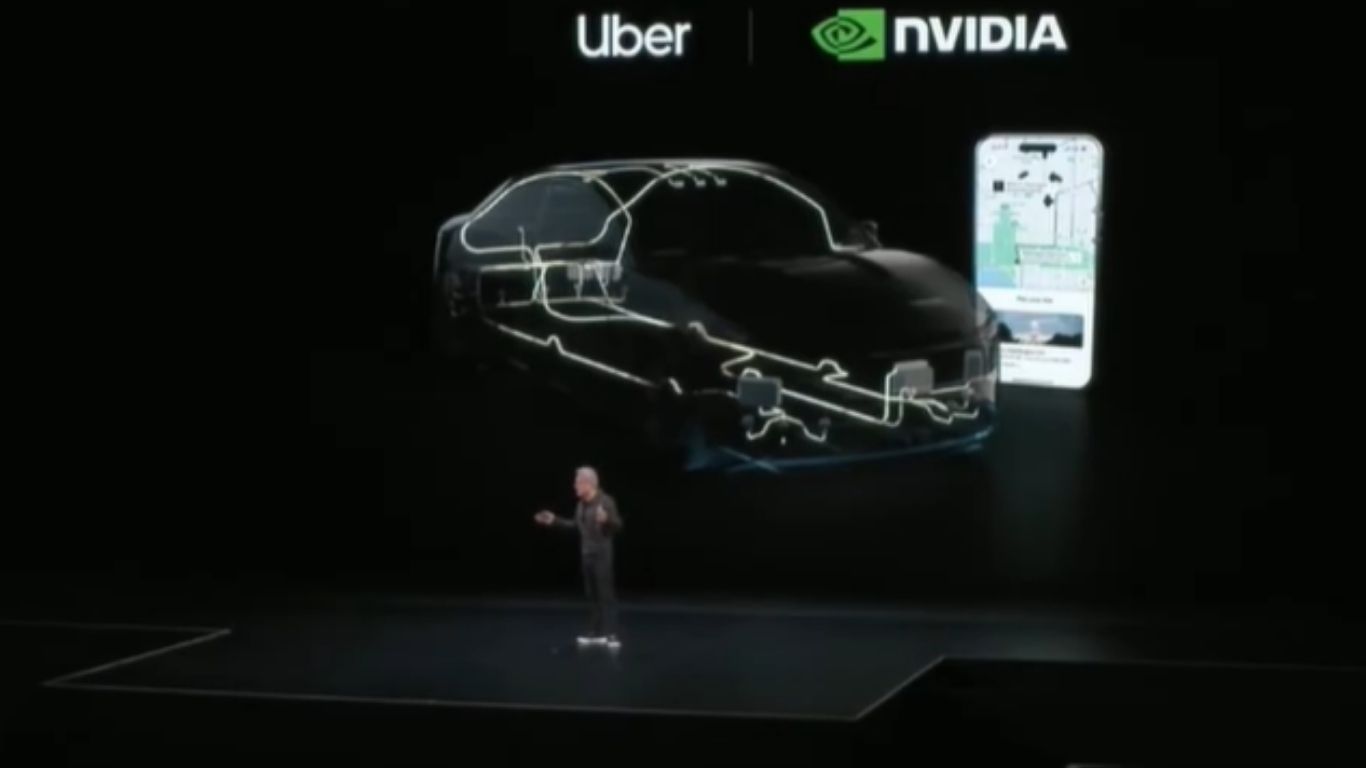
SAN JOSE, Calif. (Diya TV) — Uber Technologies and NVIDIA announced an expansion of their autonomous vehicle partnership at NVIDIA’s annual GTC conference on March 16, 2026. The companies plan to deploy a fleet of fully software-driven Level 4 robotaxis across 28 cities worldwide by 2028, beginning in Los Angeles and San Francisco in the first half of 2027.
The deal outlines a plan to deploy a global fleet of 100,000 Level 4 robotaxis, spanning North America, Europe, Australia, and Asia. Shares of Uber jumped 5.6% on March 17, closing at a multi-year high of $78.83 following the announcement.
At the core of the deal is new technology from NVIDIA. The deployment will be built on the NVIDIA DRIVE Hyperion platform and powered by Alpamayo, a reasoning-based AI model designed to handle complex and less predictable driving situations — such as construction zones and erratic pedestrian behavior — using advanced chain-of-thought logic. This marks NVIDIA’s evolution into a full-stack Level 4 software provider, a significant step beyond its prior role as a hardware and chip supplier to the autonomous vehicle industry.
The rollout will follow a phased approach in each city. Each launch city will start with a fleet of data-collection vehicles to train the Alpamayo engine on city-specific driving conditions, followed by an operator-led phase, before transitioning to fully driverless Level 4 operations.
The partnership extends well beyond just the two companies. Global automakers BYD, Geely, Isuzu, and Nissan have adopted the NVIDIA DRIVE Hyperion platform, while ride-hailing platforms Bolt, Grab, and Lyft are also leveraging DRIVE Hyperion to accelerate autonomous mobility initiatives. A specialized pilot program in Tokyo is also scheduled for late 2026, utilizing Nissan vehicles equipped with the NVIDIA DRIVE Hyperion 10 platform.
Both CEOs framed the deal as a landmark moment for the industry. Uber CEO Dara Khosrowshahi said the partnership lays “the foundation for an increasingly multi-player AV world, ensuring broad commercialization and helping to bring robotaxi service to more riders over time.” NVIDIA founder and CEO Jensen Huang described it as a turning point for physical AI, saying robotic systems can now reason about the complexities of the physical world, and that NVIDIA is delighted to connect its large ecosystem of robotaxi-ready partners to the Uber network.
Analysts at Bank of America maintained a Buy rating on Uber stock with a price target of $103, saying Uber appears positioned to have robotaxis from multiple automakers operating in Los Angeles and San Francisco by 2027, and that the expanded NVIDIA partnership could result in a growing roster of AV suppliers making the outlook more favorable in the medium term.
The Uber-NVIDIA deal is part of a broader push by Uber to dominate the robotaxi market. The company already offers driverless rides in Atlanta, Austin, Dallas, and Phoenix in the U.S., as well as several cities in the Middle East, and aims to offer driverless rides across 15 cities by the end of 2026. Amazon subsidiary Zoox has also struck a deal to have its autonomous vehicles available in the Uber app in Las Vegas this summer, while Uber separately partnered with Nuro and Lucid Motors to deploy a robotaxi service using Lucid Gravity vehicles, set to debut in late 2026.