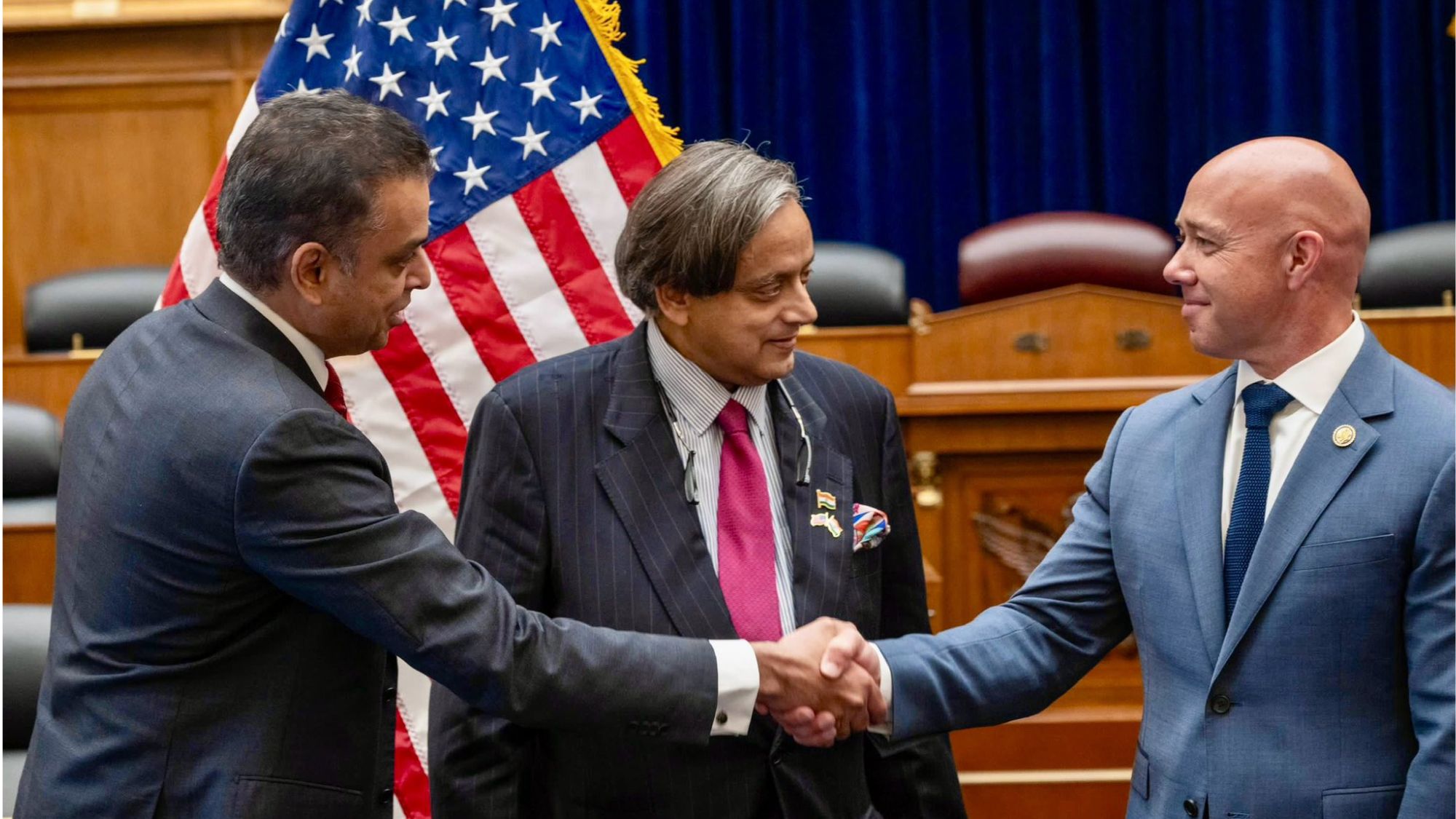
WASHINGTON (Diya TV) — India and the United States are deepening their strategic partnership, focusing on shared concerns over terrorism, economic cooperation, and bilateral trade, according to Shiv Sena Member of Parliament Milind Deora during his visit to Washington on June 4. Speaking as part of an Indian multi-party delegation, Deora highlighted the growing collaboration between the two democracies in the wake of recent terrorist attacks in Kashmir and ongoing geopolitical challenges.
Deora addressed questions regarding the evidence linking Pakistan to the Pahalgam terror attack during the delegation’s diplomatic outreach, known as Operation Sindoor. He affirmed that while concrete evidence is understood and acknowledged by global partners, the focus remains on reinforcing India-U.S. cooperation.
“Nobody will bring it up because Pakistan has no international credibility,” Deora said. “The first response we receive from anyone we’ve met—from Guyana to the United States—is that Pakistan is a rogue state, a banana republic.” He added, “People very clearly understand that India has nothing to gain by responding to Pakistan unless there’s credible evidence,” referring to the broader context of Pakistan-sponsored terrorism, including the 2008 Mumbai attacks.
Deora stressed the transformation in India-U.S. relations over the past two decades, driven by shared values and mutual interests in combating terrorism. “We both understand cross-border terrorism very well. We understand Pakistan sponsors terrorism extremely well,” he said.
This understanding has paved the way for expanded cooperation, including strong bipartisan support in the U.S. Congress. “We received a very warm welcome on Capitol Hill,” Deora noted, mentioning unequivocal statements from members of the House and Senate Foreign Relations Committees and the India Caucus condemning Pakistan-sponsored terrorism.
Beyond security, economic ties between India and the U.S. are also strengthening, with both countries eager to finalize a bilateral trade agreement. Deora highlighted the shift in global supply chains post-COVID-19 and the shared “America First” and “India First” policies aimed at reshoring jobs and boosting employment. “We are hopeful that a bilateral trade agreement will be concluded very soon,” he said. “American investments in India have delivered massive results back home.” He cited the example of Blackstone, which has invested approximately $50 billion in India’s real estate market, making it the company’s second-largest real estate market after the U.S.
Congress MP Shashi Tharoor, leading the all-party delegation, elaborated on the symbolism behind “Operation Sindoor,” India’s counterterrorism response to the April 22 Pahalgam attack. Sindoor, the traditional vermilion mark applied by Hindu married women, was brutally wiped away in the attack, sparking the operation’s name and India’s resolve. “The terrorists spared the women but shot men in front of their wives and children,” Tharoor recounted. “One wife screamed ‘Kill me too,’ but was told, ‘No, you go back and tell them what we’ve done.’”
Tharoor explained the military dimension of the operation, noting that Indian forces successfully struck 11 Pakistani military airfields, damaging runways and command centers across a wide geographic range—from Hyderabad in southern Pakistan to Peshawar in the northwest. “The Pakistanis publicly admitted that Indian strikes were so wide-ranging and effective,” he said.
The delegation’s visit follows diplomatic engagements in Brazil and aims to clarify India’s stance on terrorism while fostering greater understanding among global partners about the challenges India faces. The group includes representatives from multiple Indian political parties and former Indian Ambassador to the U.S., Taranjit Singh Sandhu.
Deora adds the evolving India-U.S. partnership is built on a foundation of shared democratic values, economic interests, and a united front against terrorism. “This relationship has completely transformed,” he said. “Broadening the scope of cooperation on terrorism is critical, and so is expanding economic ties to create opportunities for both nations.”