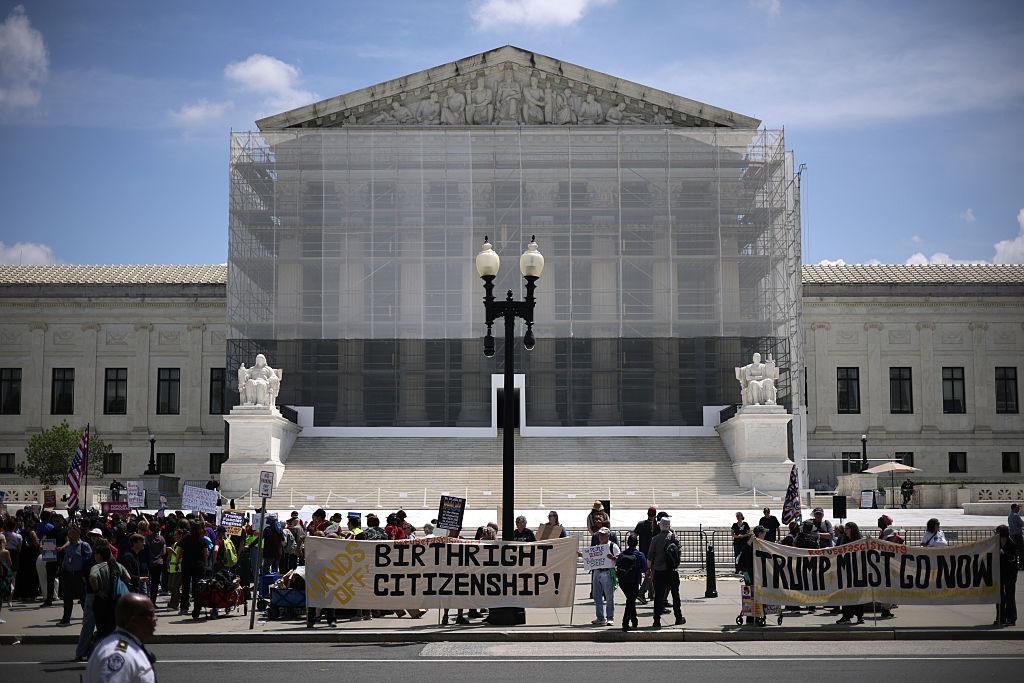
WASHINGTON (Diya TV) — The U.S. Supreme Court ruled 6-3 Tuesday that President Donald Trump’s executive order seeking to end birthright citizenship is unconstitutional, preserving more than a century of legal precedent guaranteeing automatic citizenship to nearly all children born on American soil.
Chief Justice John Roberts wrote the majority opinion in the case, Trump v. Barbara, joined by Justices Sonia Sotomayor, Elena Kagan, Amy Coney Barrett and Ketanji Brown Jackson. Roberts wrote that “citizenship, then and now, was the right to have rights — to freely participate in our political community. The Framers of the Fourteenth Amendment extended that promise to every free-born person in this land. We keep that promise today.” Addressing the administration’s argument that citizenship should hinge on a parent’s “domicile,” Roberts wrote there was “scant evidence for this dramatically revisionist view,” adding that words like “mother,” “father,” “lawful” and “temporary” appear in Trump’s executive order but are absent from the Citizenship Clause itself “for a simple reason: they did not matter.”
Justice Brett Kavanaugh concurred in the judgment but dissented in part, arguing the order violated federal statute rather than the Constitution directly. Justices Clarence Thomas, Samuel Alito and Neil Gorsuch dissented. Alito wrote in his dissent that “the Court has made a serious mistake.”
Trump signed the order on his first day in office in January 2025, seeking to deny citizenship to U.S.-born children of parents who were in the country illegally or on temporary visas. The order never took effect, as it was blocked by every federal court that reviewed it. An estimated 255,000 children born annually to non-citizen parents would have lost legal status under the order, according to the Migration Policy Institute, with some potentially rendered stateless.
The Fourteenth Amendment’s Citizenship Clause, ratified in 1868, grants citizenship to all persons born or naturalized in the United States and subject to its jurisdiction. Congress codified that interpretation into federal law in 1940 and again in 1952, and the Supreme Court first affirmed the broad rule of birthright citizenship in the 1898 case United States v. Wong Kim Ark, with narrow exceptions for the children of foreign diplomats, occupying armies and, until a 1924 law granted them citizenship, Native Americans.
While the 6-3 vote settled the constitutional question, the justices split 5-4 on a separate, narrower issue: whether Congress could limit birthright citizenship by statute in the future. Kavanaugh suggested in his opinion that Congress could hold statutory power to limit birthright citizenship, even as he joined the majority in ruling that the president could not do so unilaterally by executive order. That question remains unresolved and sets up the likely next phase of the fight.
A coalition including the ACLU, ACLU affiliates in New Hampshire, Maine and Massachusetts, the NAACP Legal Defense Fund, the Asian Law Caucus and the Democracy Defenders Fund brought the case on behalf of three families proceeding under pseudonyms, representing a Honduran asylum applicant, a Taiwanese student visa holder and a Brazilian green card applicant. The groups filed suit on Inauguration Day.
ACLU National Legal Director Cecillia Wang, who argued the case before the justices in April, said the ruling confirms that a president cannot rewrite the Constitution by executive order. “We’ve already heard from our three clients, who are the representatives of the class here, who all have said… they’ve been under this cloud where the president of the United States was trying to undo this foundational right that all Americans have relied on for 150 years,” Wang said, adding that the clients “are gratified by this decision.” ACLU Executive Director Anthony Romero called it “one of the most important constitutional cases of the past 100 years,” noting it was “especially gratifying” that Trump appointees Kavanaugh and Barrett joined the majority to strike down the order.
In dissent, Thomas argued the Fourteenth Amendment was written primarily to secure citizenship for formerly enslaved Black Americans and was not meant to extend automatically to children of foreign temporary visitors. Alito wrote separately that the ruling preserves an incentive for illegal immigration and leaves the U.S. bound to what he called an outdated rule that even the United Kingdom, where the concept originated, has since abandoned.
Trump attended oral arguments in April, becoming the first sitting president in modern history to appear in person at the Supreme Court. Reacting to the loss, Trump posted on Truth Social: “The Supreme Court upheld Birthright Citizenship, which is too bad for our Country, but we can easily make it up in Congress through Legislation, with the support of the President, that has now been determined during this process. No long and unwieldy Constitutional Amendment is necessary! Congress should start TODAY to work on ending expensive and unfair to our Country, Birthright Citizenship. They will have my Complete and Total Support! President DONALD J. TRUMP.” House Speaker Mike Johnson said Tuesday that Congress would take up the issue.
South Asian American advocacy groups celebrated the ruling as a major victory for immigrant communities. Kalpana V. Peddibhotla, executive director of the South Asian American Justice Collaborative, said the decision reflects “the power of collective advocacy,” noting her organization had joined a coalition urging the Supreme Court to reject the order and filed an amicus brief outlining its potential harms to South Asian American families.
Asian Law Caucus Executive Director Aarti Kohli, whose organization was part of the legal team representing the plaintiffs alongside the ACLU and other co-counsel, said the victory belongs to “the Black Americans whose freedom struggle gave us the 14th Amendment, to the Chinese community that funded Wong Kim Ark’s fight in 1898, to our clients who bravely came forward, and to every person who showed up and made this work possible.”
Chintan Patel, executive director of Indian American Impact, said Indian and South Asian immigrant families were among those most directly threatened by the order, pointing to communities navigating long visa backlogs where children are often born in the U.S. before their parents secure permanent status. “Today, the Supreme Court looked at those families and said: your children are American. They belong here,” Patel said.
Tuesday’s ruling marks the second major defeat for Trump’s second-term agenda at the Supreme Court, following a February decision striking down many of his tariffs. While the decision settles the constitutional question for now, Trump’s call for congressional legislation — paired with the court’s 5-4 split on Congress’s statutory authority — signals the fight over birthright citizenship is not over. For now, the more than century-old guarantee that all children born on U.S. soil are American citizens stands intact.