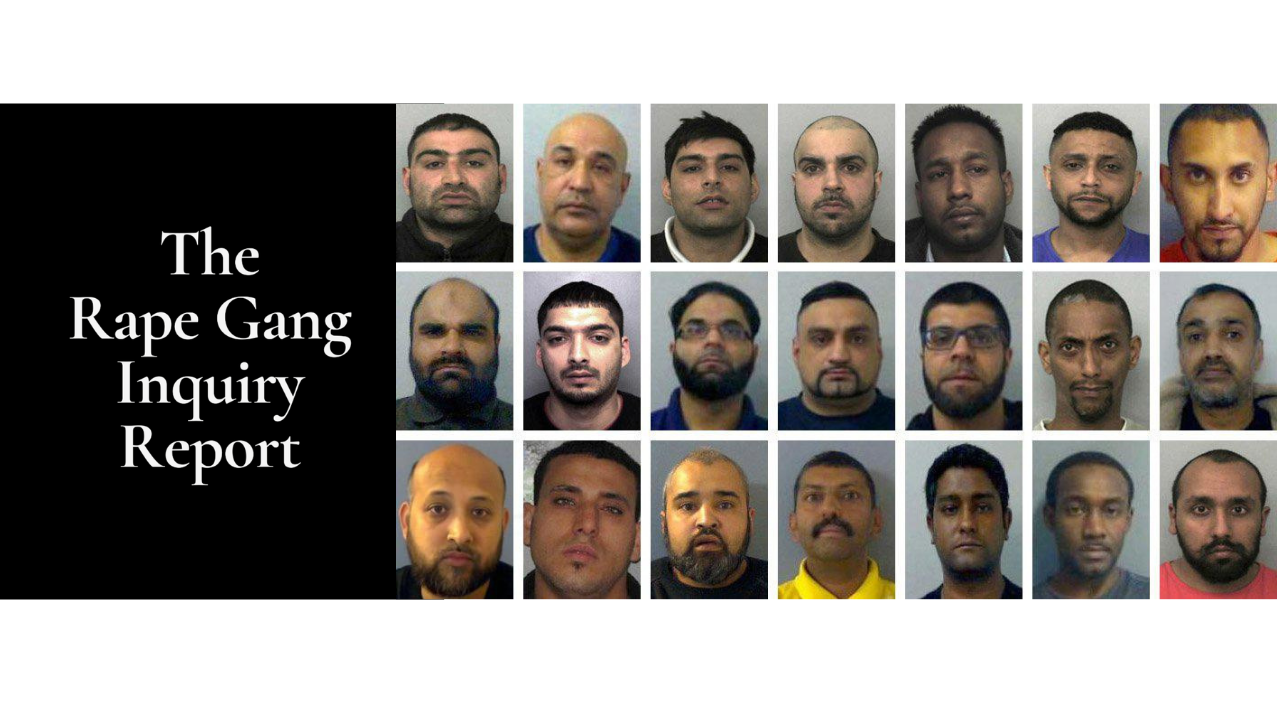
LONDON (Diya TV) — A privately funded parliamentary inquiry into organized child sexual exploitation in Britain has released a 219-page report concluding that at least 250,000 girls — and likely more — were subjected to gang rape, trafficking, torture, and coerced pregnancy over several decades, with the perpetrators overwhelmingly of Pakistani Muslim heritage and the enabling institutions overwhelmingly of the British state.
The Rape Gang Inquiry, chaired by Reform UK Member of Parliament Rupert Lowe and led operationally by survivor and advocate Sammy Woodhouse, was funded by more than 20,000 donors after crowdfunding approximately £800,000 (more than $1 million). It lacked statutory powers but drew testimony from survivors, whistleblowers, politicians, and experts across multiple public hearings. The report was published in June 2026 as the first phase of the inquiry’s work.
The inquiry was established, its authors write, because the state and its institutions had “failed catastrophically over decades.” Police, social services, schools, the NHS, licensing authorities, and successive governments at both the local and national level allowed organized networks of men to operate with what the report describes as the “active or passive consent of the British state.”
The report places the first recorded case of specifically Pakistani gang rape in Britain in 1955, when four Bradford-based Pakistani men were charged with raping a 15-year-old girl from Middlesbrough, shortly after former colonial subjects became eligible to enter the United Kingdom in substantial numbers under the British Nationality Act 1948. The scale of the offending escalated significantly, the report argues, following Tony Blair’s 1997 election victory and what it calls “orchestrated mass immigration” in the years that followed.
The 250,000 figure originates from a 2019 House of Lords statement by Lord Pearson of Rannoch, who extrapolated from the Jay Report’s findings in Rotherham — where at least 1,400 girls were abused between 1997 and 2013 — alongside comparable inquiries in Telford, Oxford, Rochdale, and elsewhere. The inquiry endorses this as a “conservative estimate,” noting that the British state never systematically recorded the full scale of the abuse, that sexual violence of all kinds is typically under-reported, and that The Independent found nearly 19,000 children identified as sexual exploitation victims in England in a single year even amid institutional resistance to naming the problem.
The inquiry found evidence of gang operations in at least 149 local authority districts — close to 40 percent of all such districts across the United Kingdom. A geographic map included in the report shows affected areas from the far north to the south coast.
In court records and official inquiries, approximately 87 percent of those convicted in group-based child sexual exploitation cases bore distinctively Muslim names, according to research cited by the inquiry. A 2017 Quilliam Foundation analysis of 264 convictions between 2005 and 2017 found 84 percent of offenders were South Asian, with the vast majority identified as Pakistani Muslim. Dr. Taj Hargey, an imam at the Oxford Islamic Congregation, is quoted in the report as estimating that approximately 95 percent of gang members are Muslim — a figure, the inquiry notes, that vastly exceeds the Muslim share of the overall British population, which stands at approximately 6.5 percent, with Pakistanis comprising roughly 2.1 percent.
The report also found smaller networks from Somali, Iranian, Syrian, Turkish, and other Muslim backgrounds among those involved.
The method of grooming followed a consistent pattern across geography and decade. Girls as young as 11 were initially befriended by a young Muslim man who treated them like adults and provided alcohol, drugs, and cigarettes. After weeks or months, girls were collected from school gates, care homes, and streets in taxis and taken to houses, flats, restaurants, and hotels where they were raped repeatedly by groups of men. Many were filmed for blackmail, beaten, burned with cigarettes, passed between perpetrators across city lines, made pregnant, coerced into abortions, and in some cases trafficked overseas — including, testimony indicates, to Pakistan, where some were subjected to sharia marriage ceremonies. Victims were routinely told they were “white trash” or “kuffar” who deserved punishment for not being Muslim.
The testimony section of the report runs to more than 100 pages and presents anonymized accounts from dozens of survivors. One witness, identified only as “Chloe,” described being first raped at age 11 after her father’s death left her in the custody of an abusive stepfather and her mother’s neglect rendered her vulnerable. She was missing for six months at age 14, trafficked across Britain to “house after house” and “guy after guy,” while her photograph was shown on television as a missing child. Her abusers acknowledged recognizing her from the broadcasts. Officers who eventually found her released the South Asian Muslim man she was with without charge. She later became anorexic, weighing five stone at age 18, after gang members who occupied her home addicted her to heroin as a method of control.
Another witness, identified as “Michelle,” reported being groomed from age 13 by three adult Pakistani brothers who supplied alcohol and drugs, and said she was raped by between 600 and 700 different men over three years — an account the inquiry presents alongside documentation of her multiple pregnancies from rape, miscarriages, and a surviving child. “98 percent of them were Pakistani Muslim,” she told the inquiry. “If not, they were Iraqi Muslim or Kurdish.”
A witness who later obtained a medical degree, identified as Dr. Ella Hill, testified that she was explicitly told during rapes that the attacks were happening because she was white and Christian. Her abusers tracked her down after she attempted to escape and attacked her on five separate occasions that she survived. On at least five occasions she went to police with medical evidence of her injuries and was turned away each time. A lengthy written statement incorporated into Professor Lisa Oakley’s evidence to the 2022 Jay Inquiry describes the religious framework her abusers used: that non-Muslim women who appear in public are sexually available, that rape of a non-Muslim woman does not count as adultery under Islamic law, that girls are old enough for sex once they begin menstruating, and that her abusers believed they were carrying out God’s will.
The inquiry panel heard testimony from Ayaan Hirsi Ali, the Somali-born writer and former Dutch parliamentarian, who told the inquiry that center-left parties viewed Muslim voting blocs as a protected electoral base and that aggressive prosecution or deportation of perpetrators risked losing those votes.
The report’s section on institutional failures documents a consistent pattern across police forces, social services departments, the NHS, schools, and taxi licensing authorities. Police ignored repeated reports from survivors, classified child rape victims as prostitutes, destroyed evidence, allowed known rapists to walk free on bail, and in some cases — described by multiple witnesses — switched off recording devices during interviews and instructed victims to drop their complaints. Social services placed children in what the report describes as “trafficking hubs inside children’s homes,” undermined protective parents, and closed cases despite clear indicators of ongoing exploitation. One witness described a social worker attending her forced sharia marriage ceremony at age 15 and permitting her new husband’s parents to foster her — for which they received a state fostering allowance — after she became pregnant as a result of rape.
NHS staff recorded genital injuries, sexually transmitted infections in children as young as 13, rape-caused pregnancies, and suicide attempts, then discharged patients back to their abusers without safeguarding referrals or trauma care. One witness, identified as “Chloe,” was admitted to accident and emergency with internal lacerations from a broken bottle inserted into her vagina by an abuser when she was 12. No questions were asked about the nature of her injuries. Schools excluded victims rather than protecting them and failed to report older men collecting girls at the gates. Taxi licensing authorities renewed permits for drivers who the inquiry says formed the logistical backbone of the networks.
Among the whistleblowers who gave evidence, a social worker described raising trafficking concerns to Oldham council leadership and being retaliated against. Former detective constable Maggie Oliver, a whistleblower from the Rochdale investigations, testified about what she characterized as obstruction of Greater Manchester Mayor Andy Burnham’s independent review, alleging that two reviewers resigned because Greater Manchester Police blocked them from accessing vital documents and speaking with survivors. The report states that no officers in Greater Manchester were fired or stripped of their pensions for the historic failings exposed by earlier reviews.
The inquiry assigns primary political responsibility to the Labour Party. Labour-dominated councils and MPs, the report states, were briefed on the gangs long ago and later denied knowledge. In January 2025, Labour MPs voted by 364 to 111 against a Conservative amendment calling for a national statutory inquiry. Prime Minister Sir Keir Starmer and his frontbench abstained or opposed the measure, dismissing public concern as “far-right agitation,” according to the report. After the Casey National Audit was published in June 2025, the government announced a statutory inquiry but with terms of reference the report describes as deliberately narrow — limited to specific local areas and excluding systematic examination of the demographic, cultural, and religious drivers.
The report also criticizes the Conservative Party for failing, during its years in government from 2010 onward, to impose mandatory ethnicity recording or launch a full statutory inquiry despite clear evidence from Rotherham and elsewhere. Scotland, the report states, refused a dedicated inquiry until February 2026 and continues to fail to record offender ethnicity.
The report’s section on the legal framework notes that the Crime and Disorder Act 1998 and Sentencing Council guidelines explicitly permit — and in cases of demonstrated racial or religious hostility, require — an uplifted sentence. Evidence in grooming gang trials repeatedly showed perpetrators calling victims “white slags,” “white trash,” and “kuffar bitches” while shouting “Allahu Akbar.” The report states that, as far as available public records indicate, racial aggravation has never once been invoked against anti-white rape gangs, by either prosecutors or judges. By contrast, Darren Osborne, who murdered a crowd of Muslims with a van in 2017, received a 43-year minimum tariff with the racial and religious aggravation explicitly cited by the sentencing judge. The inquiry found that sentences in rape gang cases typically ran between four and 12 years for men convicted of raping dozens of children over years, with many serving as little as a third to half of their sentence. Foreign national perpetrators, it found, were rarely deported after sentencing despite powers available under the UK Borders Act 2007.
The report includes a section examining theological elements the inquiry argues provided an ideological framework for the crimes. Drawing on analysis by Dr. Mark Durie, it identifies eight aspects of classical Islamic doctrine — including the concept of Muslim supremacy derived from Quranic verses, the principle of loyalty and disavowal toward non-Muslims, male authority over women under sharia, the absence of a fixed minimum age of consent in Islamic law, the institution of sex slavery authorizing sexual relations with non-Muslim captives, and the system of dhimmitude subjugating conquered non-Muslims — as elements that, filtered through Pakistani clan culture, the report argues enabled and in some cases religiously justified the crimes. The report acknowledges that not all Muslim communities are influenced equally and notes the comparative rarity of convictions involving Indian-origin Muslims, attributing the difference partly to the social context of Muslim minority status within Hindu-majority India versus Muslim-majority Pakistan.
Recommendations in the report include a new Childhood Sexual Exploitation Act creating a specific offense of “organized group-based child sexual exploitation” with mandatory minimum sentences of 50 years for ringleaders and 25 years for participants; automatic deportation of all foreign nationals convicted of such offenses; automatic loss of British citizenship for dual nationals convicted of such offenses, applied retrospectively; deportation proceedings against family members found to have harbored or failed to report perpetrators; closure of mosques and community organizations that harbored perpetrators; a dedicated national compensation scheme funded by levies on convicted perpetrators’ assets and the pensions of public servants found guilty of culpable negligence; a dedicated overseas taskforce within the Foreign, Commonwealth and Development Office to locate and repatriate British victims trafficked abroad; and a ban on visas for nationals of countries disproportionately represented in rape gang convictions.
The report also calls for a referendum on reinstating the death penalty for what it describes as the most heinous crimes, and calls for civil and private legal actions against individuals in Parliament the inquiry holds responsible.
The inquiry’s chair, Rupert Lowe MP, writes in the foreword that the root cause of the scandal is immigration, beginning with the British Nationality Act 1948 and escalating under Blair from 1997 onward. “Oil and water do not mix,” he writes, “and cultural differences, going back centuries, are the genesis of this problem.”
The report states that following publication it intends to release the full witness testimonies, gather additional survivor accounts, identify responsible individuals in Parliament by name, and begin civil and private legal actions.
The government’s statutory inquiry, announced after the Casey National Audit last year, remains ongoing.