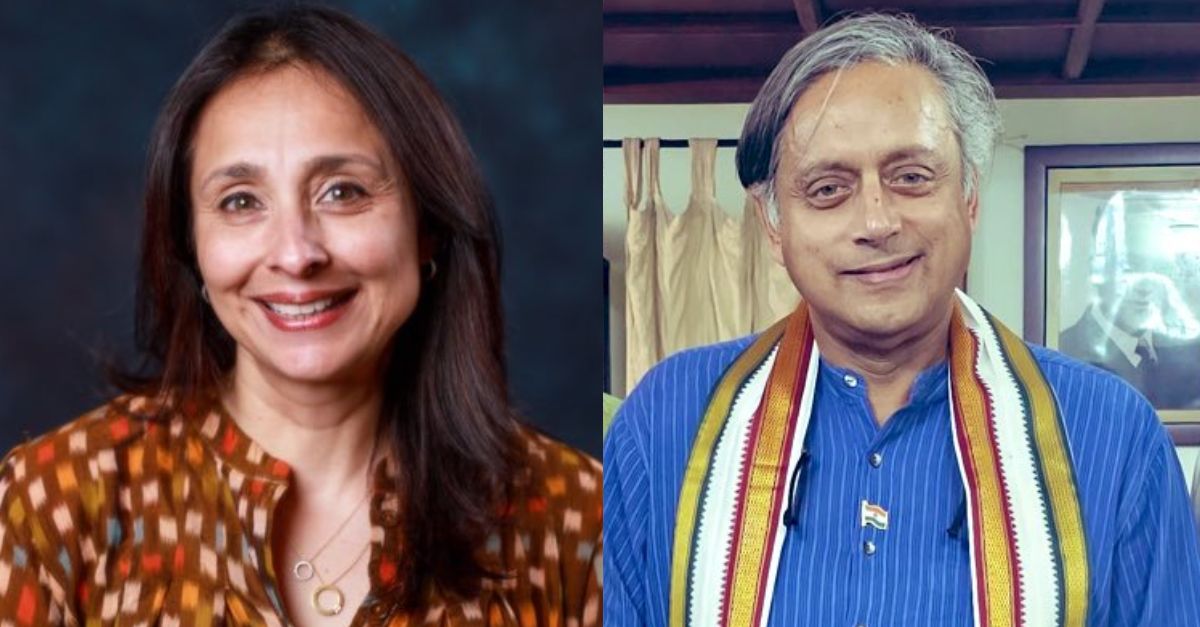
WASHINGTON (Diya TV) — Hindu American Foundation (HAF) Executive Director Suhag A. Shukla has pushed back against Indian National Congress MP Shashi Tharoor’s recent comments suggesting that the Indian American community has been “silent” on issues affecting India-U.S. relations.
In an article published in The Print, Shukla said Tharoor’s remarks misrepresented the diaspora’s political engagement and ignored the complex realities of how it operates within the American political system.
“There are 535 members in the U.S. Congress—100 senators and 435 representatives. But the honorable Shashi Tharoor made sweeping claims about the Indian American diaspora based on the words of just one in that cohort,” Shukla wrote, referring to Tharoor’s earlier comments citing a U.S. congresswoman who said she had not received calls from Indian American constituents over President Donald Trump’s policies.
Shukla, who co-founded HAF, said Tharoor’s conclusion painted an inaccurate picture of a politically active and civically engaged community. She noted that the Indian American diaspora has long worked to strengthen India-U.S. ties—quietly, consistently, and always within U.S. law.
“We do so without a full picture, without any formal role in shaping India’s policies, and always within the strictures of U.S. law,” Shukla said. “It is disingenuous, dangerous even, to suggest we do otherwise.”
Shukla also defended the community’s dual identity, saying civic engagement in the U.S. does not conflict with emotional or cultural ties to India.
“Just as India and Indian citizens have a duty to pursue their national interest, the United States and its citizens, including Indian Americans, have a duty to pursue ours,” she wrote. “This recognition is not a betrayal of our heritage, but a simple fact of citizenship.”
She stressed that Indian Americans are loyal U.S. citizens who contribute meaningfully to both American and global societies. “Indian Americans do not exist to serve as proxies for the Government of India,” she added. “We exist as Americans—citizens endowed with rights, responsibilities, and loyalties rooted in this soil.”
In her article, Shukla highlighted several ongoing challenges the community faces in the United States. She pointed to legislative actions such as California’s SB509 and proposed federal bills targeting “transnational repression,” which she warned could enable “mass surveillance and profiling” of Indian and Hindu Americans.
“Statements like Mr. Tharoor’s don’t merely misrepresent the diaspora; they embolden those who never believed we were true Americans to begin with,” she cautioned.
Shukla also emphasized that while Indian Americans support stronger India-U.S. relations, expecting them to bear the political and financial costs of these efforts is unfair. “We agree India deserves a stronger voice on the global stage,” she said. “Expecting Indian Americans, increasingly under attack from both ends of the political spectrum, to continue sacrificing and paying for it, however, is not a sound strategy.”
Tharoor responded to Shukla’s critique on X, saying he welcomed her perspective. “I welcome the pushback from @SuhagAShukla,” Tharoor wrote. “If my questions about the silence of the diaspora have got Indian Americans thinking, I am happy.”
He clarified that his comparison with other ethnic groups, including Jewish Americans and Cuban Americans, was meant to encourage greater civic participation. “Their challenges are indeed different from those of Jewish Americans and Cuban Americans, the examples I cited in my piece,” he wrote. “But that doesn’t mean that within the rules of U.S. democracy, they can’t make their voices heard — as these other groups so effectively do!”
Shukla acknowledged Tharoor’s stature as a respected statesman and writer but urged greater care in how Indian politicians discuss the diaspora. “His words carry weight,” she wrote. “That’s why they must be measured.”
She argued that sweeping generalizations about Indian Americans can harm their credibility in U.S. political spaces. “Indian Americans have worked hard to build trust and influence in a complex system,” she said. “They deserve recognition for their contributions, not criticism based on limited anecdotes.”