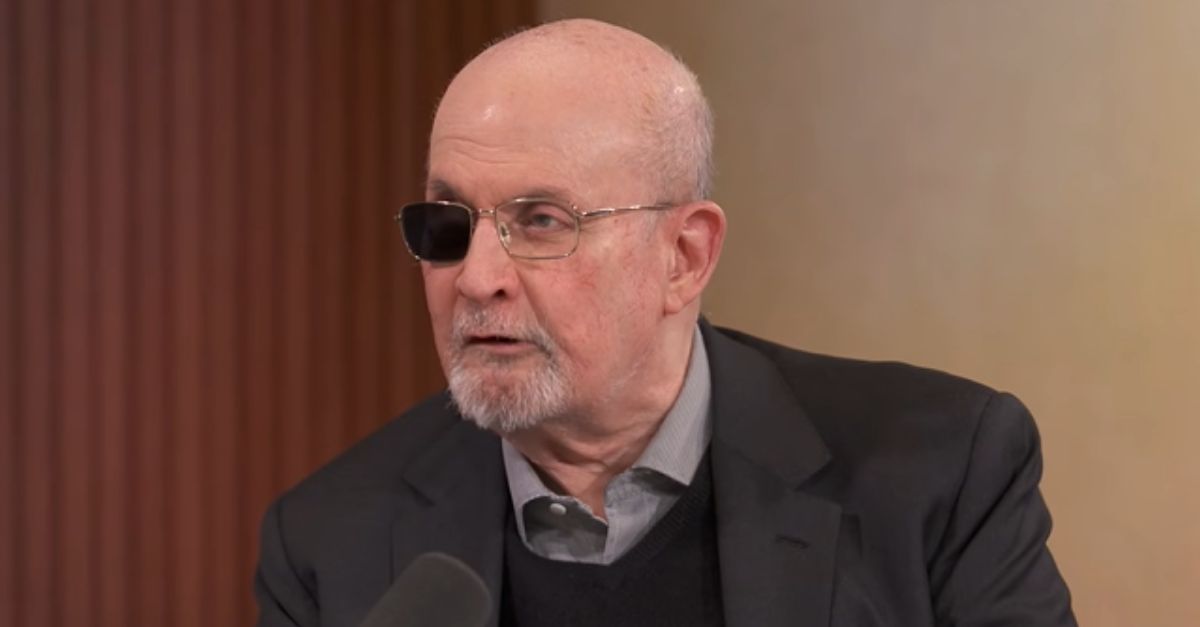
LONDON (Diya TV) — Booker Prize-winning author Salman Rushdie has raised alarms over the rise of book bans in parts of the United States, warning that the trend threatens free expression. In a recent interview on Bloomberg’s The Mishal Husain Show, the Indian-born British and American novelist said he was shocked by the scale of the censorship. “I would never have imagined it,” Rushdie said.
Rushdie has lived in the United States since 2000 and became a U.S. citizen in 2016. He explained that one of the reasons he moved to America was the protection of free speech in the U.S. Constitution. “One of the reasons why people like me wanted to live in America is because free speech is enshrined in the Constitution,” he said.
According to PEN America, a nonprofit advocacy group, nearly 23,000 books have been banned in U.S. public schools since 2021. The group calls this “without precedent.” Rushdie described many of the banned books as “some of the best books ever,” including classics such as Beloved by Toni Morrison and To Kill a Mockingbird by Harper Lee.
Rushdie called the recent wave of book bans “dangerous,” noting that many targeted titles address perspectives of people who are not White. He said limiting voices to only the dominant perspective can have a “deeply unsettling effect on society.”
“My view has always been let voices be heard, especially if I disagree with them,” Rushdie said. “It’s no trick to allow somebody to hold up a placard that you agree with.” He stressed that free expression is tested most when society allows opinions that challenge its own beliefs.
Rushdie also pointed to parallels between censorship in the U.S. and India. In 1988, India banned his novel The Satanic Verses. The ban was lifted in 2024, decades after Iran’s Grand Ayatollah Ruhollah Khomeini issued a fatwa calling for Rushdie’s death. In 2022, Rushdie survived a stabbing at a New York event, leaving him blind in one eye.
Throughout his career, Rushdie has been active in defending free speech. His memoir, Joseph Anton, recounts years spent in hiding following the fatwa. He has consistently argued that protecting dissent is essential for a functioning democracy.
Rushdie also criticized the UK government’s decision to label the activist group Palestine Action as a proscribed terrorist organization. The designation has led to arrests of people who held signs supporting Palestine. “Probably a mistake,” Rushdie said, emphasizing that public protest is a vital part of free expression.
His latest work, the short-story collection The Eleventh Hour, revisits the neighborhood from his 1981 novel Midnight’s Children. The new book explores themes of free speech and public discourse, reflecting the author’s ongoing concern with society’s ability to tolerate diverse opinions.
Rushdie warned that book bans in the U.S. could have worldwide effects. Restricting literature not only limits individual learning but also pressures writers and readers globally. He believes that society benefits when difficult and diverse ideas are allowed to flourish.
“The real test of free expression is when it is uncomfortable,” Rushdie said. “Protecting dissent is what keeps democracy alive.”
Rushdie’s comments come at a time of growing debate over the role of schools and libraries in deciding what content is appropriate for young readers. The U.S. Department of Education has defended such measures, calling them “commonsense procedures” for reviewing age-inappropriate material. As Rushdie’s warnings make clear, the conversation about censorship and free speech continues to resonate far beyond the United States.