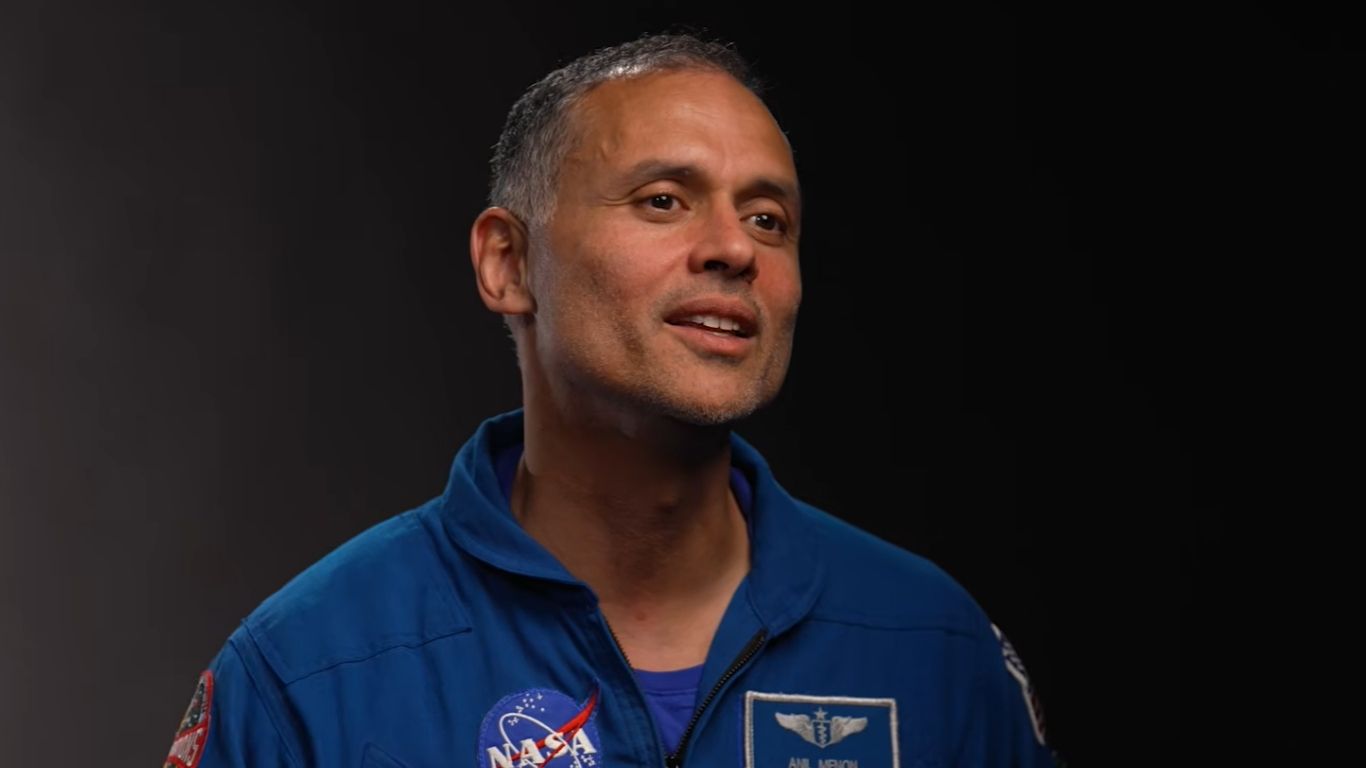
HOUSTON, Texas (Diya TV) — Indian American NASA astronaut Anil Menon has discovered that one of the biggest surprises of life aboard the International Space Station is not spacewalks or science experiments. Instead, it is the strange habit of everyday objects disappearing in microgravity.
Just one week into his first space mission, Menon shared a lighthearted post on X about the challenge. He said living in orbit has filled him with unforgettable moments. However, he admitted that keeping track of simple items has become one of the station’s most unexpected tasks.
Menon explained that objects can drift away almost as soon as astronauts let go of them. In the weightless environment, even a gentle touch or air flowing through the station can send an item floating in another direction. As a result, astronauts must pay close attention to everything they use.
“I’ve been in space for one week,” Menon wrote on X. “There are so many awe-inspiring and amazing sights, emotions, and work.” He added that he found it remarkable how easily an inanimate object could seem to lose itself aboard the International Space Station.
Without Earth’s gravity, objects do not stay where astronauts leave them. Instead, they continue moving after even the smallest push. Because of this, a pen, tool, or piece of clothing can quietly float into another part of the station. Consequently, astronauts often spend extra time searching for missing belongings.
Menon said he quickly learned the importance of securing personal items. At first, he attached a pen to his pants with Velcro. Later, he realized the pen had disappeared anyway. A fellow crew member then suggested using a string to tie the pen directly to his clothing. That simple method worked better.
Even so, not every object cooperated. Menon also secured a Rubik’s Cube to the ceiling of his sleeping quarters with Velcro. However, when he woke up the next morning, most of the puzzle had somehow vanished. The incident added another amusing chapter to life aboard the orbiting laboratory.
The design of the International Space Station also makes finding lost objects more difficult. Unlike on Earth, astronauts do not have a fixed sense of up or down. Therefore, after turning through different modules, they can easily lose their sense of direction. Something left in plain sight may suddenly seem impossible to find.
Menon shared another example from his daily routine. His sleeping quarters measure only about the size of a telephone booth. Even so, he spent several minutes searching for a missing shirt one morning. Eventually, he chose another shirt instead. Later that day, the missing one unexpectedly reappeared.
The unusual experience is not unique to Menon. He recalled hearing stories from veteran astronauts about a missing water bag that reportedly resurfaced nearly 10 years after it disappeared. According to Menon, the station even displays “wanted posters” for important equipment that crews have not yet located. Those stories highlight how common the problem has become during long missions in orbit.
Still, teamwork remains the best solution. Menon said astronauts rely on one another whenever something goes missing. They alert fellow crew members, ask for help, and often recover the missing item after a careful search. That spirit of cooperation supports many daily activities aboard the station, from scientific research to routine maintenance.
Menon arrived at the International Space Station aboard the Soyuz MS-29 spacecraft on July 14. He is expected to spend about eight months in orbit, where he will take part in scientific experiments, technology demonstrations, and station operations. During the mission, he and his crewmates will continue studying how humans can safely live and work in space for long periods.