NEW DELHI (Diya TV) — India marked its 77th Republic Day on Monday with a carefully choreographed display of military power, constitutional history and diplomatic outreach, as leaders from the European Union joined celebrations amid accelerating shifts in global trade and geopolitics.
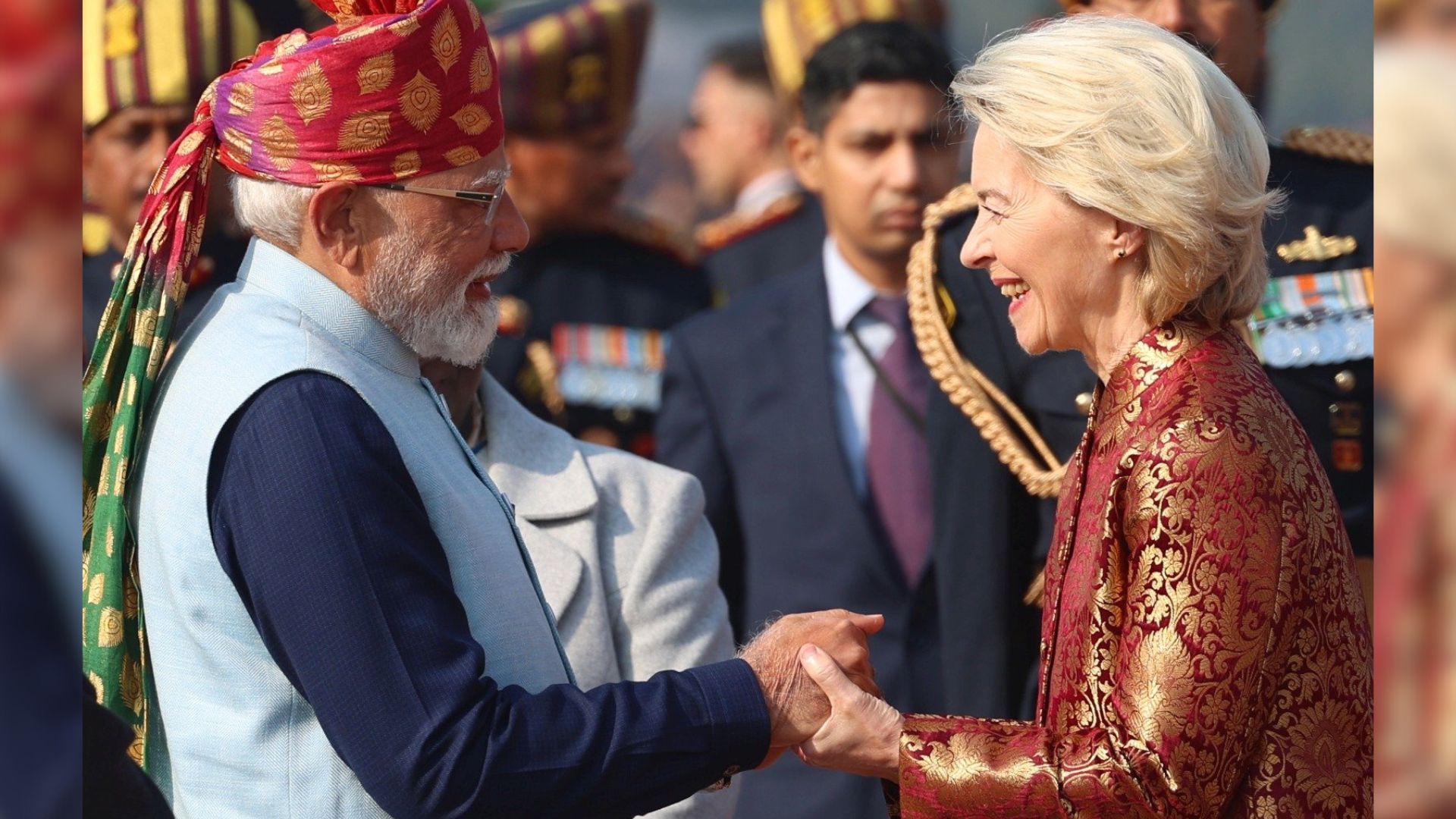
Indian President Droupadi Murmu unfurled the national flag along Kartavya Path, the ceremonial boulevard formerly known as Rajpath, as European Commission President Ursula von der Leyen and European Council President Antonio Costa attended as chief guests. Their presence underscored what Indian officials have described as a pivotal moment in relations between India and the 27-nation bloc, with both sides expected to announce progress on a long-delayed free trade agreement during an accompanying EU-India summit.
This year’s parade carried a sharper strategic tone. Against the backdrop of Operation Sindoor, launched in May 2025, India showcased a phased “Battle Array Format” for the first time, integrating ground troops with aerial assets. The display included a high-mobility reconnaissance vehicle and India’s first indigenously developed armoured light specialist vehicle. In another first, a military contingent from the European Union marched in the parade, marking the EU’s debut participation in a military parade outside Europe.
The central theme of the celebrations, “150 Years of Vande Mataram,” linked modern military imagery with the deeper roots of Indian nationalism. Cultural tableaux, mounted cavalry units and massed military bands reinforced the blend of tradition and state power that has come to define Republic Day.
“The occasion inspires us in our collective resolve to build a developed India,” Indian Prime Minister Narendra Modi said ahead of the parade.
Republic Day commemorates January 26, 1950, when India’s Constitution came into force and the country formally became a sovereign democratic republic. At 10:18 a.m. that morning, in the Durbar Hall of what is now Rashtrapati Bhavan, Chakravarti Rajagopalachari, India’s last Governor-General, proclaimed the end of dominion status. Rajendra Prasad was sworn in minutes later as the nation’s first President. India’s oldest defence magazine, Fauji Akhbar, recorded the moment with precision, noting that a 31-gun salute echoed across Delhi shortly after 10:30 a.m.
The first Republic Day parade later unfolded at the Irwin Amphitheatre — today’s Major Dhyan Chand National Stadium — before thousands of citizens and foreign dignitaries, including Indonesian President Sukarno. The event transformed a colonial military ritual into a public assertion of unity and self-rule.
Seventy-five years on, Republic Day has become both a remembrance and a geopolitical signal. Von der Leyen called her role as chief guest “the honor of a lifetime,” writing that “a successful India makes the world more stable, prosperous and secure,” and emphasizing Europe’s “clear choice” of strategic partnership with New Delhi. Costa echoed that message, highlighting cooperation on trade, security and clean energy in a post marking the 16th EU-India summit.
Trade has become an urgent driver of that partnership. India-EU trade in goods reached €120 billion ($139 billion) in 2024, nearly doubling over the past decade, according to European Union figures. Negotiations on a free trade deal, stalled for years, accelerated in 2025 after President Donald Trump imposed steep tariffs on both Indian and Chinese goods.
Republic Day also drew messages from across the globe. Chinese President Xi Jinping congratulated Murmu, calling China and India “good neighbours, friends and partners,” and said improved ties were “of great significance for maintaining and promoting world peace and prosperity,” according to China’s state news agency Xinhua. The remarks come after Beijing and New Delhi began repairing relations following deadly border clashes in 2020, even as bilateral trade surpassed $130 billion annually, according to Reuters.
French President Emmanuel Macron also sent greetings, recalling his attendance at last year’s celebrations and referring to Modi as a “dear friend.”
U.S. Ambassador to India Sergio Gor attended the Republic Day Parade for the first time, saying in a social media post he was ‘thrilled to see the U.S.-made aircraft soaring in the Indian sky, a powerful symbol of the strength of the U.S.-India strategic partnership.”
As India positions itself to become the world’s fourth-largest economy this year, according to International Monetary Fund projections, Republic Day increasingly serves as a window into the country’s ambitions. The spectacle evolves, alliances shift and trade priorities sharpen, but the core promise made on a winter morning in 1950 — governance by Constitution, democracy and popular will — remains the enduring centerpiece of this national ritual.