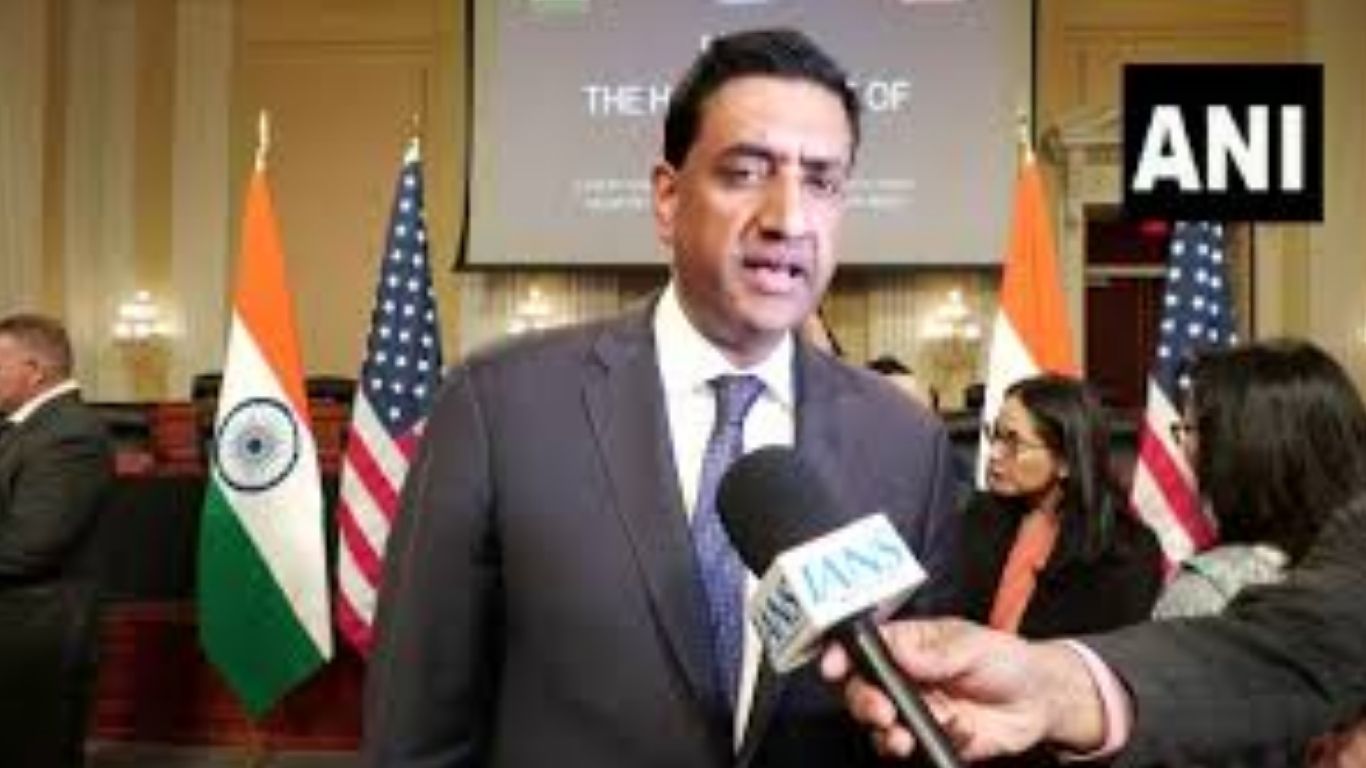
FREMONT, Calif. (Diya TV) — Rep. Ro Khanna (D-CA) announced on June 1, 2026 that he is cosponsoring H.Res. 69, a House resolution that celebrates the contributions of Hindu Americans and condemns Hinduphobia and anti-Hindu bigotry. The resolution was introduced by Indian American Congressman Shri Thanedar, a Democrat from Michigan, and has now gained support from 32 lawmakers, including Congressmen Raja Krishnamoorthi and Suhas Subramanyam.
The resolution is formally titled “Celebrating Hindu Americans, condemning attacks on Hindu places of worship, Hinduphobia, and anti-Hindu bigotry, and for other purposes.” Specifically, the resolution celebrates the historical and ongoing contributions of Hindus and Hinduism to the United States, recognizes the vibrant Hindu culture that enriches American cultural diversity, declares the United States as a place that welcomes the diversity brought by Hindu Americans, and condemns Hinduphobia, anti-Hindu bigotry, hate, and intolerance.
CoHNA Chief Communications Officer Pushpita Prasad told Diya TV that the resolution comes at a critical time for Hindu Americans.
“We are pleased to see the growing support for H.Res. 69, and the problem of Hinduphobia in the U.S. Coming against a backdrop of 11 temple attacks since 2023, and rising hate in both the online and real world, the resolution is much overdue, since the first step to solving a problem is recognizing it,” Prasad said.
“All too often we have seen actions that explicitly target Hindu practices, deities and festivals, get swept under the more generic rug of racism, or anti-immigrant hate, sometimes even when the attacker and victims hail from the same race,” she added. “We have also seen elite academics and activists work to sanitize, rationalize and even deny the hate Hindus face, as though the recognition of hate against one community in some way attacks the rights of other communities.”
The resolution was introduced on January 24, 2025, and referred to committee. As a simple House resolution, it is used for matters affecting just one chamber of Congress and carries no force of law.
Thanedar re-introduced the resolution in January 2025 in response to what he described as an alarming rise in anti-Hindu sentiment in the United States, citing multiple instances of anti-Hindu violence over the prior year from New York to California, as well as a concerning amount of racism and xenophobia directed at the Hindu-American diaspora community.
Hindu Americans number approximately 3.37 million, representing roughly 1 percent of the U.S. population, with the largest concentrations in California, New Jersey, New York, Massachusetts, and Illinois.
The resolution has not been without controversy. Progressive Hindu and South Asian groups have expressed concern about the legislation, saying that while anti-Hinduism sentiment does exist, the term “Hinduphobia” was invented by the Indian far-right to shut down criticism of Indian Prime Minister Narendra Modi’s government.
Hindus for Human Rights, a progressive civil rights organization, said in a statement: “In many cases, instances of anti-Indian sentiment, general xenophobia, or even mistaken Islamophobia are misleadingly labeled as ‘Hinduphobic’ regardless of whether or not there is any evidence to support claims of religious motivation. Even worse, claims of ‘Hinduphobia’ have routinely been weaponized to smear anyone — including self-identifying Hindus — who criticizes the current Indian government.”
The same organization added that the core threat to Indian American immigrants in the U.S. is white nationalism, and that the resolution “does not respond to real concerns about how Hindu Americans are affected by white Christian nationalism in the United States.”
Khanna represents California’s 17th Congressional District and co-chairs the Congressional Caucus on India and Indian Americans. Thanedar represents Michigan’s 13th Congressional District, which includes Detroit. The resolution has drawn support from both parties, with the bill classified as a slight partisan measure leaning Democratic. The resolution remains in the first stage of the legislative process, having been referred to the House Committee on Oversight and Government Reform.